Manual of Contract Documents for Highway Works

Pavement
Construction
CC 201 Pavement foundation construction
(formerly Series 800 and parts of Series 600, Series 700, Series 900 and Series 1000)
Version E/1.0.1
Summary
This document gives requirements for pavement foundation construction including foundation options, subgrade assessment, unbound and bound capping, unbound and bound subbase mixtures, and foundation testing.
This document incorporates specific requirements for National Highways. Alternative versions of this document are available for other Overseeing Organisations.
Feedback and Enquiries
Users of this document are encouraged to raise any enquiries and/or provide feedback on the content and usage of this document to the dedicated National Highways team. The online feedback form for all enquiries and feedback can be accessed at: www.standardsforhighways.co.uk/feedback.
This is a controlled document.Latest release notes
| Document Code | Version number | Date of publication of relevant change | Changes made to | Type of change |
|---|---|---|---|---|
| CC 201 | E/1.0.1 | October 2025 | Core document | Incremental change to notes and editorial updates |
| This document supersedes Series 800 and parts of Series 600, Series 700, Series 900 and Series 1000, which are withdrawn. It has been rewritten as part of the MCHW re-write and extensively restructured. Version 1.0.1 is issued to correct a publication rendering issue with figure 4.5. | ||||
Previous versions
| Document Code | Version number | Date of publication of relevant change | Changes made to | Type of change |
|---|---|---|---|---|
| CC 201 | E/1.0.0 | September 2025 | Core document | Change to policy, major revision, new document development |
Foreword
This document gives requirements for the construction of works for the Overseeing Organisation.
This document forms part of the works specification.
The works specification is made up of both the Specification for Highway Works and the Works Specific Requirements completed by the Specifier.
This document is applicable to contracts throughout the UK, complemented by the additional specification requirements and contractual changes of each Overseeing Organisation.
Users are responsible for applying all appropriate documents applicable to their contract.
Users are responsible for archiving contract documentation in accordance with the user's quality management system.
1. Pavement foundation construction
1.1 Pavement foundation construction shall be as specified in CC 201/WSR/001.
2. Restricted pavement foundation options
2.1 Restricted pavement foundation options shall be as specified in CC 201/WSR/002.
2.2 Restricted pavement foundation course materials shall be as described in CC 201/WSR/002.
3. Performance pavement foundation options
3.1 Performance pavement foundation options shall be as specified in CC 201/WSR/003.
3.2 Performance pavement foundation course materials shall be as specified in CC 201/WSR/003.
4. Subgrade assessment prior to foundation construction
Requirements and verification of construction subgrade surface modulus
4.1 The construction subgrade surface modulus for each subgrade characteristic section shall be equal or greater than the design subgrade surface modulus specified in "Pavement foundation construction" in Section 1 of this document.
4.2 Verification shall be undertaken for the subgrade surface modulus for each subgrade characteristic section by measurement using one of the following devices: Dynamic cone penetrometer (DCP) (see requirements in Dynamic cone penetrometer (DCP) testing for subgrade assessment), Falling weight deflectometer (FWD) (see requirements in Falling weight deflectometer (FWD) testing for subgrade assessment) or Lightweight deflectometer (LWD) (see requirements in Lightweight deflectometer (LWD) testing for subgrade assessment).
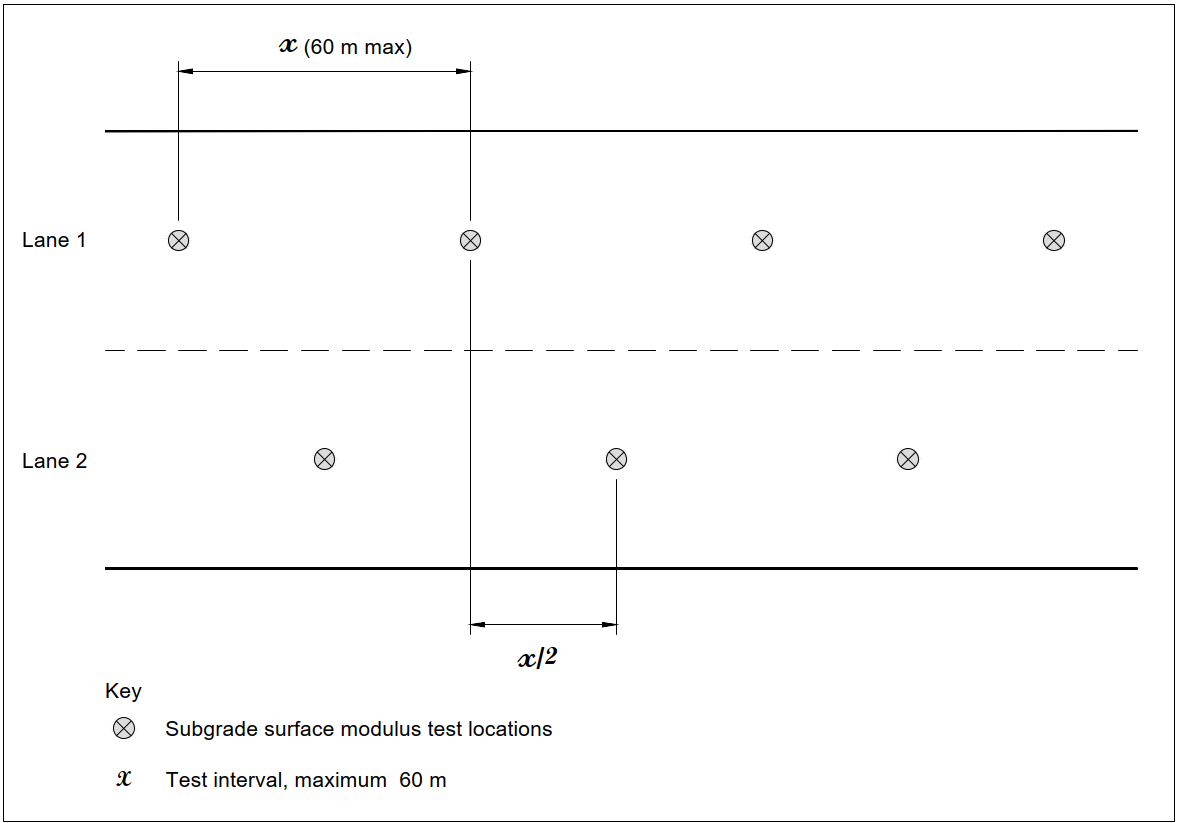
4.3 The frequency of measurement of subgrade surface modulus shall be at least 10 tests at a maximum spacing of 60 m between each test, evenly spaced along each lane of prepared subgrade and staggered to the mid-point between adjacent lanes where multiple lanes are being tested (see figure 4.5 below) unless otherwise stated in CC 201/WSR/001.
4.4 The requirements for "Verification" in Section 14 of GC 101 [Ref 19.N] shall apply to the measurement of the subgrade surface modulus.
4.5
4.6 The measurement of the construction subgrade surface modulus for each subgrade characteristic section shall be taken at formation level or at sub-formation level if capping is part of the pavement foundation design.
Dynamic cone penetrometer (DCP) testing for subgrade assessment
4.7 DCP testing shall be undertaken following the procedure outlined within CS 229 [Ref 14.N].
4.8 The California bearing ratio (CBR) value obtained shall be converted to surface modulus (E) using the equation in CD 225 [Ref 15.N].
Falling weight deflectometer (FWD) testing for subgrade assessment
4.9 FWD testing shall be undertaken using a calibrated FWD in accordance with the test procedure specified in BS 1924-2 [Ref 21.N].
Lightweight deflectometer (LWD) testing for subgrade assessment
4.10 LWD testing shall be undertaken using a calibrated LWD in accordance with BS 1924-2 [Ref 21.N].
4.11 LWD device shall only be used with a site-specific correlation versus FWD or if it has an annual correlation certificate which is current at time of testing.
4.12 The LWD testing procedure shall be as stated in CC 201/WSR/001.
Documentation for construction subgrade surface modulus
4.13 The following Documentation shall be submitted for the devices used to measure the subgrade surface modulus prior to the commencement of the construction of the pavement foundation: FWD or LWD annual calibration certificate.
5. Foundation surface levels, regularity and rectification
Requirements and verification for pavement foundation surface levels
5.1 Prior to construction of the overlying layers, the surface level of the capping shall be at the design level within the following tolerances: + 20 mm and - 30 mm, unless otherwise stated in CC 201/WSR/003.
5.2 Verification shall be undertaken for the surface level of the capping by measurement against the datum level on a grid of points not more than 2 m spacing transversely and not more than 10 m spacing longitudinally.
5.3 The frequency of measurement of surface levels shall be once prior to overlay.
5.4 The requirements for "Verification" in Section 14 of GC 101 [Ref 19.N] shall apply to the measurement of the surface level of the capping.
5.5 Prior to construction of the overlying layers, the surface level of the subbase shall be at the design level subject to the relevant tolerances stated in table 5.6, unless otherwise stated in CC 201/WSR/003.
5.6
| Permitted surface level tolerance from design level (mm) | |
| Subbase under pavement quality concrete layers | ± 10 |
| All other subbases | + 10 / - 30 |
5.7 In any length of pavement, compliance shall be deemed to be met when not more than one of 10 consecutive measurements taken longitudinally or one in any transverse line, exceeds the tolerances permitted in table 5.6.
5.8 Verification shall be undertaken for the surface level of the subbase by measurement against the datum level on a grid of points not more than 2 m spacing transversely and not more than 10 m spacing longitudinally.
5.9 The frequency of measurement of surface levels shall be once prior to overlay.
5.10 The requirements for "Verification" in Section 14 of GC 101 [Ref 19.N] shall apply to the measurement of the surface level of the subbase.
Requirements and verification for subbase longitudinal regularity
5.11 Prior to construction of pavement quality concrete layers, the longitudinal regularity of the subbase, measured as the difference between the surface and the underside of a straightedge placed parallel with the centre line of the road, shall be not more than 10 mm.
5.12 Verification shall be undertaken for the subbase longitudinal regularity in accordance with BS 8420 [Ref 31.N]using a straightedge of minimum 2 m length.
5.13 The frequency of measurement of subbase longitudinal regularity shall be one per 100 m.
5.14 The requirements for "Verification" in Section 14 of GC 101 [Ref 19.N] shall apply to the measurement of the longitudinal regularity of the subbase.
5.15 Verification for the longitudinal regularity of the subbase by measurement shall be undertaken by an accredited testing laboratory in compliance with "Accredited laboratory" in Section 16 of GC 101 [Ref 19.N].
Requirements for subbase rectification
5.16 For unbound and hydraulically bound materials, when rectification is undertaken, the area treated shall be at least 20 m long and 2 m wide.
5.17 For bituminous materials, when rectification is undertaken, the area treated shall be at least 5 m long and the full width of the pavement laid in one operation.
6. Unbound capping for pavement foundations
General requirements for unbound capping for pavement foundations
6.1 Unbound capping shall be as specified in CC 201/WSR/004.
6.2 Unbound capping shall be constructed with materials complying with class 6F1, 6F2, 6F3, 6F4, 6F5 or 6S.
Constituent requirements and verification for unbound capping for pavement foundations
6.3 Unbound capping materials shall comply with "Earthworks materials" in Section 2 of CC 601 [Ref 16.N].
Site won natural aggregates for unbound capping
6.4 Site won natural aggregates for unbound capping materials (excluding recycled aggregates) shall meet the performance characteristics as stated in table 6.4.
| Application | 6F1 | 6F2 | 6S |
| Description | Selected granular material (fine grading) | Selected granular material (coarse grading) | Selected well graded granular material |
| Permitted constituents | Any material, or combination of materials, excluding recycled aggregates and manufactured aggregates as defined in BS EN 13242 [Ref 2.N] | Crushed natural aggregate | |
| Resistance to fragmentation of coarse aggregate | LA60 | LA50 | No requirement |
| Fines quality (size fraction passing the 0.425 mm size test sieve | No requirement | Non-plastic as defined and tested in compliance with BS 1377-2 | |
6.5 Verification shall be undertaken for the resistance to fragmentation - Los Angeles coefficient (LA) of site won materials by testing in accordance with BS EN 1097-2 [Ref 43.N].
6.6 The frequency of resistance to fragmentation testing shall be once per 5000 tonnes of material.
6.7 The requirements for "Verification" in Section 14 of GC 101 [Ref 19.N] shall apply to the testing of resistance to fragmentation.
6.8 Verification shall be undertaken for the plasticity of the fraction passing the 0.425 mm test sieve for 6S site won materials by testing plasticity in accordance with BS 1377-2 [Ref 32.N].
6.9 The frequency of plasticity testing shall be once per 5000 tonnes of material unless otherwise stated in CC 201/WSR/004.
6.10 The requirements for "Verification" in Section 14 of GC 101 [Ref 19.N] shall apply to the testing of plasticity of material class 6S (site won).
6.11 Verification for the resistance to fragmentation and plasticity of aggregates by testing shall be undertaken by an accredited testing laboratory in compliance with "Accredited laboratory" in Section 16 of GC 101 [Ref 19.N].
Recycled and imported aggregates for unbound capping
6.12 Recycled (site won or imported) and imported aggregates shall be compliant with BS EN 13242 [Ref 2.N].
6.13 The aggregates shall meet the performance characteristics as stated in table 6.15.
6.14 The requirements of "Designated standards" in Section 10 of GC 101 [Ref 19.N] shall apply to imported aggregates and recycled aggregates for unbound capping.
6.15
| Application | 6F1 | 6F2 | 6F3 | 6F4 | 6F5 | 6S |
| Description | Selected granular material (fine grading) | Selected granular material (coarse grading) | Selected granular material | Selected granular material (fine grading) | Selected granular material (coarse grading) | Selected well graded granular material |
| Permitted constituents | Any material, or combination of materials including recycled aggregates with not more than 50% by mass of recycled bituminous planings and granulated asphalt, but excluding materials contaminated with tar and tar- bitumen binders, unburnt colliery spoil and argillaceous rock (see definition in CC 601.1). | Any material, or combination of materials, with not less than 50% by mass of recycled bituminous planings and granulated asphalt, but excluding materials contaminated with tar, unburnt colliery spoil and argillaceous rock (see definition in CC 601.1). Material shall be from one or more of the following source codes: A1 (reclaimed asphalt) A4 (mixed recycled aggregate) |
Unbound mixtures in accordance with BS EN 13285 [Ref 54.N]. Material shall be from one or more of the following source codes: P (natural aggregates – except chalk) A2 (crushed concrete) A3 (crushed bricks, masonry) A4 (mixed recycled aggregate) B1 (municipal incinerator bottom ash (MIBA)) D2 (air cooled blast furnace slag) D3 (basic oxygen furnace slag) D4 (electric arc furnace slag (EAF C)) G (mining and quarry industry) |
Crushed natural aggregate | ||
| Resistance to fragmentation of coarse aggregate | LA60 | LA50 | LANR | LA60 | LA50 | LANR |
| Volume stability of blast furnace slag | No requirement | Free from dicalcium silicate and iron disintegration | No requirement | |||
| Volume stability of steel (BOF and EAF) slag | No requirement | V5 | No requirement | |||
Product requirements and verification for unbound capping for pavement foundations
6.16 Unbound capping shall comply with Limiting distances of earthworks materials with elevated sulfur species in "General earthworks construction" in Section 5 of CC 601 [Ref 16.N].
6.17 The grading of unbound capping materials shall be compliant with BS 1377-2 [Ref 32.N]or BS EN 13285 [Ref 54.N].
6.18 The grading of unbound capping materials shall meet the performance characteristics as stated in table 6.19.
6.19
| Sieve size (mm) | Percentage by mass passing the sieve size | ||||||
| 6F1 | 6F2 | 6S (site won) | 6F3 | 6F4 | 6F5 | 6S (recycled or imported) | |
| Tested in accordance with | BS 1377-2 [Ref 32.N] | BS EN 13285 [Ref 54.N] | |||||
| 125 | - | 100 | - | 100 | - | 100 | - |
| 90 | - | 80 - 100 | - | - | - | - | - |
| 80 | - | - | - | 75 - 99 | - | 75 - 99 | - |
| 75 | 100 | 65 - 100 | 100 | - | - | - | - |
| 63 | - | - | - | - | 100 | - | 100 |
| 40 | - | - | - | 50 - 90 | - | 50 - 90 | - |
| 37.5 | 75 - 100 | 45 - 100 | - | - | - | - | - |
| 31.5 | - | - | - | - | 75 - 99 | - | - |
| 20 | - | - | - | 30 - 75 | - | 30 - 75 | - |
| 16 | - | - | - | - | 50 - 90 | - | - |
| 10 | 40 - 95 | 15 - 60 | - | 15 - 60 | - | 15 - 60 | - |
| 8 | - | - | - | - | 30 - 75 | - | - |
| 5 | 30 - 85 | 10 - 45 | - | - | - | - | - |
| 4 | - | - | - | - | 15 - 60 | - | - |
| 2 | - | - | 60 - 100 | 0 - 35 | - | 0 - 35 | 60 - 100 |
| 1 | - | - | - | - | 0 - 35 | - | - |
| 0.600 | 10 - 50 | 0 - 25 | 30 - 90 | - | - | - | - |
| 0.500 | - | - | - | - | - | - | 30 - 90 |
| 0.150 | - | - | 4 - 45 | - | - | - | - |
| 0.125 | - | - | - | - | - | - | 8 - 45 |
| 0.063 | 0 - 15 | 0 - 12 | 0 - 16 | 0 - 12 | 0 - 15 | 0 - 12 | 0 - 16 |
| Grading category | Not applicable | GE | Not applicable | ||||
6.20 Verification shall be undertaken for the grading of site won unbound capping by sampling and testing in accordance with BS 1377-2 [Ref 32.N].
6.21 The frequency of sampling and testing shall be once per week of production or once per 5000 tonnes, whichever is most frequent.
6.22 The requirements for "Verification" in Section 14 of GC 101 [Ref 19.N] shall apply to the grading of site won unbound capping.
6.23 Verification shall be undertaken for the grading of recycled (site won or imported) and imported unbound capping by sampling and testing in accordance with BS EN 13285 [Ref 54.N].
6.24 The frequency of sampling and testing shall be once per week of production or once per 5000 tonnes, whichever is most frequent.
6.25 The requirements for "Verification" in Section 14 of GC 101 [Ref 19.N] shall apply to the grading of recycled (site won or imported) and imported unbound capping.
6.26 Verification for grading of unbound capping shall be undertaken by an accredited testing laboratory in compliance with "Accredited laboratory" in Section 16 of GC 101 [Ref 19.N].
6.27 The asphalt content and maximum bitumen content of unbound capping materials shall be as stated in table 6.27.
| 6F1 | 6F2 | 6F3 | 6F4 | 6F5 | 6S | |
| Asphalt content (Class Ra) | Max 50% | Min 50% - Max 100% | Max 50% | Max 0% | ||
| Maximum bitumen content | 2% | 2% | 10% | 2% | 2% | Not applicable |
6.28 Verification shall be undertaken for the asphalt content of unbound capping materials by testing in accordance with BS EN 933-11 [Ref 39.N].
6.29 The frequency of asphalt content testing shall be once per week of production or once per 5000 tonnes, whichever is most frequent.
6.30 The requirements for "Verification" in Section 14 of GC 101 [Ref 19.N] shall apply to the testing of asphalt content of unbound capping materials.
6.31 Verification shall be undertaken for the bitumen content of unbound capping materials with more than 20% reclaimed asphalt content by testing in accordance with BS EN 12697-1 [Ref 7.N] or BS EN 12697-39 [Ref 8.N].
6.32 The frequency of bitumen content testing shall be once per material.
6.33 The requirements for "Verification" in Section 14 of GC 101 [Ref 19.N] shall apply to the testing of bitumen content of unbound capping materials.
6.34 Verification for asphalt content and bitumen content shall be undertaken by an accredited testing laboratory in compliance with "Accredited laboratory" in Section 16 of GC 101 [Ref 19.N].
6.35 The size fraction of material class 6S (imported) passing the 0.425 mm size test sieve shall be non-plastic.
6.36 Verification shall be undertaken for the plasticity of the fraction passing the 0.425 mm test sieve for material class 6S (imported) by testing in accordance with BS 1377-2 [Ref 32.N].
6.37 The frequency of plasticity testing shall be once per mixture type.
6.38 The requirements for "Verification" in Section 14 of GC 101 [Ref 19.N] shall apply to the testing of plasticity of material class 6S (imported).
6.39 Verification for the plasticity by testing shall be undertaken by an accredited testing laboratory in compliance with "Accredited laboratory" in Section 16 of GC 101 [Ref 19.N].
6.40 Optimum water content of 6F1, 6F2 and 6F3 unbound capping materials shall be determined.
6.41 Verification shall be undertaken for the optimum water content of 6F1 and 6F2 unbound capping materials by testing in accordance with the vibrating hammer method in BS 1377-2 [Ref 32.N].
6.42 The frequency of optimum water content testing shall be once per mixture.
6.43 The requirements for "Verification" in Section 14 of GC 101 [Ref 19.N] shall apply to the testing of optimum water content of 6F1 and 6F2 unbound capping materials.
6.44 Verification shall be undertaken for the optimum water content of 6F3 unbound capping material by testing in accordance with BS 1377-2 [Ref 32.N], the oven dry method by using a reduced temperature of 45 to 50°C.
6.45 The frequency of optimum water content testing shall be once per mixture.
6.46 The requirements for "Verification" in Section 14 of GC 101 [Ref 19.N] shall apply to the testing of optimum water content of 6F3 unbound capping materials.
6.47 Laboratory dry density and optimum water content of 6F4 and 6F5 unbound capping materials shall be determined.
6.48 Verification shall be undertaken for the laboratory dry density and optimum water content of 6F4 and 6F5 unbound capping materials by testing in accordance with BS EN 13285 [Ref 54.N].
6.49 The frequency of laboratory dry density and optimum water content testing shall be once per mixture.
6.50 The requirements for "Verification" in Section 14 of GC 101 [Ref 19.N] shall apply to the testing of laboratory dry density and optimum water content of 6F4 and 6F5 unbound capping materials.
6.51 Verification for dry density and water content by testing shall be undertaken by an accredited testing laboratory in compliance with "Accredited laboratory" in Section 16 of GC 101 [Ref 19.N].
Frost heave requirements and verification for unbound capping materials
6.52 Unbound capping materials shall be non-frost susceptible where used within 450 mm of the designed final surface and 350 mm if the Mean Annual Frost Index (MAFI) of the site is less than 50, unless otherwise stated in CC 201/WSR/004.
6.53 Non-frost susceptible unbound capping materials shall have a mean maximum frost heave of 15 mm.
6.54 Verification shall be undertaken for the frost heave of unbound capping materials by testing in accordance with BS 812-124 [Ref 30.N]using comparator specimens as per Annex B.
6.55 The frequency of frost heave testing shall be once per source per year.
6.56 The requirements for "Verification" in Section 14 of GC 101 [Ref 19.N] shall apply to the testing of the frost heave of unbound capping materials.
Product documentation for unbound capping for pavement foundations
6.57 The following Documentation shall be submitted for site won unbound capping materials (6F1, 6F2 and 6F3) prior to the commencement of the capping construction: optimum water content report.
6.58 The requirements for "Documentation" in Section 2 of GC 101 [Ref 19.N] shall apply to the optimum water content report.
6.59 The following Documentation shall be submitted for imported unbound capping materials (6F4 and 6F5) prior to the commencement of the capping construction: dry density and optimum water content report.
6.60 The requirements for "Documentation" in Section 2 of GC 101 [Ref 19.N] shall apply to the dry density and optimum water content report.
Installation requirements and verification for unbound capping for pavement foundations
6.61 Installed unbound capping shall comply with "Foundation surface levels, regularity and rectification" in Section 5 of this document.
6.62 The minimum compacted layer thickness of 6F1, 6F2, 6F3, 6F4 and 6F5 unbound capping shall be 110 mm.
6.63 The minimum layer thickness of 6S unbound capping shall be 50 mm.
6.64 The maximum nominal thickness of unbound capping material 6F3 installed in one layer shall be 200 mm.
6.65 The maximum nominal thickness of unbound capping materials 6F1, 6F2, 6F4 and 6F5 installed in one layer shall be 250 mm.
6.66 The lowest layer of unbound capping layers of unequal thickness shall be the thickest layer.
6.67 Site won unbound capping materials (6F1 and 6F2) and 6F3 shall be laid and compacted at + 0% / - 2% of the declared optimum water content.
6.68 Verification shall be undertaken for the water content of site won unbound capping materials (6F1 and 6F2) by testing in accordance with BS 1377-2 [Ref 32.N].
6.69 The frequency of water content testing shall be once per week of production or once per 5000 tonnes, whichever is most frequent.
6.70 The requirements for "Verification" in Section 14 of GC 101 [Ref 19.N] shall apply to the testing of water content of site won unbound capping.
6.71 Verification shall be undertaken for the water content of imported unbound capping materials (6F3) by testing in accordance with the oven dry method of BS 1377-2 [Ref 32.N], by using a reduced temperature of 45 to 50 °C.
6.72 The frequency of water content testing shall be once per week of production or once per 5000 tonnes, whichever is most frequent.
6.73 The requirements for "Verification" in Section 14 of GC 101 [Ref 19.N] shall apply to the testing of water content of 6F3 unbound capping.
6.74 Imported unbound capping materials (6F4 and 6F5) shall be laid and compacted at + 0% / - 2% of the declared optimum water content.
6.75 Verification shall be undertaken for the water content of imported unbound capping materials (6F4 and 6F5) by testing in accordance with BS EN 1097-5 [Ref 42.N].
6.76 The frequency of water content testing shall be once per week of production or once per 5000 tonnes, whichever is most frequent.
6.77 The requirements for "Verification" in Section 14 of GC 101 [Ref 19.N] shall apply to the testing of water content of 6F4 and 6F5 unbound capping.
6.78 Verification for water content shall be undertaken by an accredited testing laboratory in compliance with "Accredited laboratory" in Section 16 of GC 101 [Ref 19.N].
6.79 Trafficking of filter layers constructed with 6S material shall be limited to the traffic directly engaged in the depositing, spreading and compaction of the 6S material.
6.80 The leading edge of the 6S material shall not extend more than 100 m beyond the leading edge of the subbase layer.
6.81 Compaction of unbound capping (6F1, 6F2, 6F3, 6F4 and 6F5) shall be carried out by a method specified in table 6.81, unless it is demonstrated at site trials that a state of compaction achieved by an alternative method is equivalent to or better than that using the specified method.
| Type of compaction plant | Category | Minimum number of passes for layers not exceeding the following compacted thicknesses: |
||
| 110 mm | 150 mm | 250 mm | ||
| Smoothed wheeled roller (or vibratory roller operating without vibration) | Mass per metre width of roll: | |||
| over 2100 kg up to 2700 kg | unsuitable | unsuitable | unsuitable | |
| over 2700 kg up to 5400 kg | 16 | unsuitable | unsuitable | |
| over 5400 kg | 8 | 16 | unsuitable | |
| Grid roller | Mass per metre width of roll: | |||
| over 2700 kg up to 5400 kg | unsuitable | unsuitable | unsuitable | |
| over 5400 kg up to 8000 kg | 20 | unsuitable | unsuitable | |
| over 8000 kg | 12 | 20 | unsuitable | |
| Deadweight tamping roller | Mass per metre width of roll: | |||
| over 4000 kg up to 6000 kg | 12 | 20 | unsuitable | |
| over 6000 kg | 8 | 12 | 20 | |
| Pneumatic-tyred roller | Mass per wheel: | |||
| over 1000 kg up to 1500 kg per wheel | unsuitable | unsuitable | unsuitable | |
| over 1500 kg up to 2000 kg per wheel | unsuitable | unsuitable | unsuitable | |
| over 2000 kg up to 2500 kg per wheel | unsuitable | unsuitable | unsuitable | |
| over 2500 kg up to 4000 kg per wheel | unsuitable | unsuitable | unsuitable | |
| over 4000 kg up to 6000 kg per wheel | 12 | unsuitable | unsuitable | |
| over 6000 kg up to 8000 kg per wheel | 12 | unsuitable | unsuitable | |
| over 8000 kg up to 12000 kg per wheel | 10 | 16 | unsuitable | |
| over 12000 kg per wheel | 8 | 12 | unsuitable | |
| Vibratory tamping roller | Mass per metre width of a vibrating roll: | |||
| over 700 kg up to 1300 kg per metre width of a vibrating roll | unsuitable | unsuitable | unsuitable | |
| over 1300 kg up to 1800 kg per metre width of a vibrating roll | 12 | unsuitable | unsuitable | |
| over 1800 kg up to 2300 kg per metre width of a vibrating roll | 8 | 12 | unsuitable | |
| over 2300 kg up to 2900 kg per metre width of a vibrating roll | 6 | 10 | unsuitable | |
| over 2900 kg up to 3600 kg per metre width of a vibrating roll | 6 | 10 | unsuitable | |
| over 3600 kg up to 4300 kg per metre width of a vibrating roll | 4 | 8 | unsuitable | |
| over 4300 kg up to 5000 kg per metre width of a vibrating roll | 3 | 7 | 12 | |
| over 5000 kg per metre width of a vibrating roll | 3 | 6 | 10 | |
| Vibratory roller | Mass per metre width of vibrating roll: | |||
| over 270 kg up to 450 kg per metre width of vibratory roll | unsuitable | unsuitable | unsuitable | |
| over 450 kg up to 700 kg per metre width of vibratory roll | unsuitable | unsuitable | unsuitable | |
| over 700 kg up to 1300 kg per metre width of vibratory roll | 16 | unsuitable | unsuitable | |
| over 1300 kg up to 1800 kg per metre width of vibratory roll | 6 | 16 | unsuitable | |
| over 1800 kg up to 2300 kg per metre width of vibratory roll | 4 | 6 | 12 | |
| over 2300 kg up to 2900 kg per metre width of vibratory roll | 3 | 5 | 11 | |
| over 2900 kg up to 3600 kg per metre width of vibratory roll | 3 | 5 | 10 | |
| over 3600 kg up to 4300 kg per metre width of vibratory roll | 2 | 4 | 8 | |
| over 4300 kg up to 5000 kg per metre width of vibratory roll | 2 | 4 | 7 | |
| over 5000 kg per metre width of vibratory roll | 2 | 3 | 6 | |
| Vibrating plate compactor | Mass per m2 of base plate: | |||
| over 880 kg up to 1100 kg per m2 of base plate | unsuitable | unsuitable | unsuitable | |
| over 1100 kg up to 1200 kg per m2 of base plate | unsuitable | unsuitable | unsuitable | |
| over 1200 kg up to 1400 kg per m2 of base plate | unsuitable | unsuitable | unsuitable | |
| over 1400 kg up to 1800 kg per m2 of base plate | 8 | unsuitable | unsuitable | |
| over 1800 kg up to 2100 kg per m2 of base plate | 5 | 8 | unsuitable | |
| over 2100 kg per m2 of base plate | 3 | 6 | 12 | |
| Vibro-tamper | Mass: | |||
| over 50 kg up to 65 kg | 4 | 8 | unsuitable | |
| over 65 kg up to 75 kg | 3 | 6 | 12 | |
| over 75 kg up to 100 kg | 2 | 4 | 10 | |
| over 100 kg | 2 | 4 | 10 | |
| Power rammer | Mass: | |||
| 100 kg up to 500 kg | 5 | 8 | unsuitable | |
| over 500 kg | 5 | 8 | 14 | |
| Dropping-weight compactor | Mass of rammer over 500 kg weight drop: | |||
| over 1 m up to 2 m of rammer over 500 kg weight drop | unsuitable | unsuitable | unsuitable | |
| over 2 m of rammer over 500 kg weight drop | unsuitable | unsuitable | unsuitable | |
6.82 Where more than one class of material is being used, capping shall be compacted with plant operating as if only the material which requires the greater compactive effort is being compacted.
6.83 The minimum number of passes N is the minimum number of times that each point on the surface of the layer being compacted shall be traversed by the item of compaction plant in its operating mode, or struck by power rammers or falling weight compactors.
6.84 The compaction plant in table 6.81 shall be categorised in terms of static mass.
6.85 The mass per metre width of roll in table 6.81 shall be the total mass on the roll divided by the total roll width.
6.86 Where a smooth wheeled roller has more than one axle, the category of the machine in table 6.81 shall be determined on the basis of the axle giving the highest value of mass per metre width.
6.87 A grid roller shall be a machine with a compacting roll or rolls constructed of heavy steel mesh of square pattern.
6.88 A deadweight tamping roller shall be a machine with a roll or rolls from which ‘feet’ project, where the projected end area of each 'foot' exceeds 0.01 m2 and sum of the areas of the 'feet' exceeds 15% of the area of the cylinder swept by the ends of the 'feet'.
6.89 If only one tamping roll of a deadweight tamping roller traverses each point on the surface of the layer on any one pass of the machine, the minimum number of passes shall be twice the number given in table 6.81.
6.90 For pneumatic-tyred rollers, the mass per wheel shall be the total mass of the roller divided by the number of wheels.
6.91 In assessing the number of passes of pneumatic-tyred rollers, the effective width shall be the sum of the widths of the individual wheel tracks together with the sum of the spacings between the wheel tracks provided that each spacing does not exceed 230 mm.
6.92 Where the spacings exceed 230 mm the effective width of pneumatic-tyred rollers shall be the sum of the widths of the individual wheel tracks only.
6.93 A vibratory tamping roller, which can be self-propelled or towed, shall be a machine having a means of applying mechanical vibration to one or more rolls. The rolls have projected feet where the height of each foot exceeds 10% radius of the roll drum, the projected end area of each foot exceeds 0.1% of the roll drum surface area, and the sum of the areas of the feet exceeds 10% of the area of the cylinder swept by the ends of the feet.
6.94 The requirements for the operation of vibratory tamping rollers shall be the same as those stated for vibratory rollers except that vibratory tamping rollers operating without vibration will be classified as dead weight tamping rollers.
6.95 Vibratory rollers shall be self-propelled or towed smooth-wheeled rollers having means of applying mechanical vibration to one or more rolls.
6.96 The number of passes in table 6.81 for vibratory rollers with a self-propelled machine with mechanical transmission are based on operation of the machine in the lowest gear. If higher gears are used an increased number of passes shall be provided in proportion to the increase in speed of travel.
6.97 The number of passes in table 6.81 for vibratory rollers for a towed machine, or a self propelled machine with hydrostatic transmission are based on a speed of 1.5 to 2.5 km/h. If higher speeds are used an increased number of passes shall be provided in proportion to the increase in speed of travel.
6.98 Where the mechanical vibration is applied to two rolls in tandem, the minimum number of passes shall be half the number given in table 6.81 for the mass per metre width of one vibrating roll.
6.99 Where one roll of a vibratory roller differs in mass per metre width from the other, the number of passes shall be calculated as for the roll with the smallest value or by treating the machine as having a single vibrating roll with a mass per metre width equal to that of the roll with the higher value.
6.100 Vibratory rollers shall be operated with their vibratory mechanism operating only at the frequency of vibration recommended by the manufacturers.
6.101 Where more than one amplitude setting is available and/or a range of frequencies is recommended, the machine shall be operated at the maximum amplitude setting and at the maximum recommended frequency for that setting.
6.102 Vibratory rollers shall be equipped or provided with devices indicating the frequency at which the mechanism is operating and the speed of travel.
6.103 Vibrating plate compactors shall have a base plate which is attached to a source of vibration consisting of one or two eccentrically weighted shafts.
6.104 The mass per square metre of base plate of a vibrating plate compactors shall be calculated by dividing the total mass of the machine in its working condition by its area in contact with compacted material.
6.105 Vibrating plate compactors shall be operated at the frequency of vibration recommended by the manufacturer.
6.106 Where vibrating plate compactors are operated at travelling speeds higher than 1 km/h, the number of passes shall be increased in proportion to the increase in speed of travel.
6.107 Vibro-tampers shall be machines in which an engine-driven reciprocating mechanism acts on a spring system through which oscillations are set up in a base plate.
6.108 Power rammers shall be machines which are actuated by explosions in an internal combustion cylinder, each explosion being controlled manually by the operator.
6.109 Dropping weight compactors shall be machines in which a dead weight is dropped from a controlled height using a hoist mechanism and they include self-propelled machines with mechanical traversing mechanisms capable of compacting soil in trenches and close to structures.
6.110 In the case of power rammers and dropping-weight compactors one pass shall be counted as one strike applied by the compacting shoe.
6.111 Where combinations of different types or categories of plant are used, the depth of layer shall be that for the type of plant requiring the least depth of layer.
6.112 Where combinations of different types or categories of plant are used, the number of passes shall be that for the type of plant requiring the greatest number of passes.
6.113 On completion of compaction and prior to construction of the overlaying layers, the surface of any layer of unbound capping shall be free from cracks, loose material, potholes, ruts or other defects.
Verification of unbound capping for performance foundations
6.114 Performance pavement foundations shall comply with "Performance pavement foundation testing" in Section 13 of this document.
7. Bound capping for pavement foundations
General requirements for bound capping for pavement foundations
7.1 Bound capping shall be as specified in CC 201/WSR/005.
7.2 Chemical analysis shall be as specified in CC 201/WSR/005.
7.3 Bound capping for restricted foundations shall be constructed with materials complying with class 9A, 9B, 9C, 9D, 9E or 9F.
7.4 Bound capping for performance foundations shall be constructed with constituents complying with class 9P.
Constituent requirements and verification for bound capping for pavement foundations
7.5 Materials to be stabilised with cement shall comply with class 6E, 7F or 7G.
7.6 Materials to be stabilised with lime shall comply with class 7E.
7.7 Materials to be stabilised with lime and cement shall comply with class 6R or 7I.
7.8 Materials classed as 6E, 6R, 7E, 7F, 7G and 7I shall comply with "Earthworks materials" in Section 2 of CC 601 [Ref 16.N].
7.9 Site won natural aggregates classed as 6E, 6R, 7E, 7F, and 7I to be stabilised to form bound capping shall meet the performance characteristics as stated in table 7.9.
| Capping material class | 6E (site won) | 6R (site won) | 7F (site won) | 7E (site won) | 7I (site won) |
| Application |
For stabilisation with cement to form capping (Class 9A) or for performance foundations (Class 9P) | For stabilisation with lime and cement to form capping (Class 9F) or for performance foundations (Class 9P) | For stabilisation with cement to form capping (Class 9B) or for performance foundations (Class 9P) | For stabilisation with lime to form capping (Class 9D) or for performance foundations (Class 9P) | For stabilisation with lime and cement to form capping (Class 9E) or for performance foundations (Class 9P) |
| Description | Selected granular material. | Selected silty cohesive material. | Selected cohesive material. | ||
| Permitted constituents | Any material, or combination of materials, excluding recycled aggregates and manufactured aggregates as defined in BS EN 13242 [Ref 2.N]. | Any material, or combination of materials, excluding recycled aggregates and manufactured aggregates as defined in BS EN 13242 [Ref 2.N]. | Any material, or combination of materials, excluding recycled aggregates and manufactured aggregates, as defined in BS EN 13242 [Ref 2.N]. | ||
| Water content | See Bound capping in CC 201/WSR/005, or CC 207/WSR/002 (not applicable to chalk) | ||||
| Liquid limit | ≤ 45 (not applicable to chalk) | No requirement | |||
| Plasticity index | ≤ 20 | ≤10 | |||
| Organic matter | See Bound capping in CC 201/WSR/005, or CC 207/WSR/002 | ||||
| Maximum water soluble sulfate (WS) content (mg/l as SO4) | 3000 | See Chemical analysis in CC 201/WSR/005, or CC 207/WSR/002 | |||
| Maximum oxidisable sulfides (OS) content (as SO4) | 0.6% | See Chemical analysis in CC 201/WSR/005, or CC 207/WSR/002 | |||
| Maximum total potential sulfate (TPS) content | No requirement | See Chemical analysis in CC 201/WSR/005, or CC 207/WSR/002 | |||
| Maximum saturation water content (SMC) of chalk | 20% | No requirement | |||
| Maximum intact lump dry density (IDD) of chalk | No requirement | See Bound capping in CC 201/WSR/005, or CC 207/WSR/002 | No requirement | ||
| MCV | No requirement | See Bound capping in CC 201/WSR/005, or CC 207/WSR/002 | |||
7.10 Verification shall be undertaken for the water content of site won materials for stabilisation by testing in accordance with BS 1377-2 [Ref 32.N].
7.11 The frequency of water content testing shall be once per 400 tonnes unless otherwise stated in CC 201/WSR/005.
7.12 The requirements for "Verification" in Section 14 of GC 101 [Ref 19.N] shall apply to the testing of water content of site won materials for stabilisation to form bound capping.
7.13 Verification shall be undertaken for the liquid limit of site won materials for stabilisation by testing in accordance with BS 1377-2 [Ref 32.N].
7.14 The frequency of liquid limit testing shall be daily.
7.15 The requirements for "Verification" in Section 14 of GC 101 [Ref 19.N] shall apply to the testing of liquid limit of site won materials for stabilisation to form bound capping.
7.16 Verification shall be undertaken for the plasticity of site won materials for stabilisation by testing in accordance with BS 1377-2 [Ref 32.N].
7.17 The frequency of plasticity testing shall be daily.
7.18 The requirements for "Verification" in Section 14 of GC 101 [Ref 19.N] shall apply to the testing of plasticity of site won materials for stabilisation to form bound capping.
7.19 Verification shall be undertaken for the organic matter of site won materials for stabilisation by testing in accordance with BS 1377-3 [Ref 33.N].
7.20 The frequency of organic matter testing shall be twice weekly unless otherwise stated in CC 201/WSR/005.
7.21 The requirements for "Verification" in Section 14 of GC 101 [Ref 19.N] shall apply to the testing of organic matter of site won materials for stabilisation to form bound capping.
7.22 Verification shall be undertaken for the water soluble sulfate and oxidisable sulfides content of site won materials for stabilisation by testing in accordance with BS EN 1744-1 [Ref 37.N].
7.23 The frequency of water soluble sulfate and oxidisable sulfides content testing shall be twice weekly with a minimum of five samples per mixture, using the two higher values to obtain the mean value for comparison with the limiting values. If ten or more results are available the mean is to be calculated using the highest 20% of the results unless otherwise stated in CC 201/WSR/005.
7.24 The requirements for "Verification" in Section 14 of GC 101 [Ref 19.N] shall apply to the testing of water soluble sulfate and oxidisable sulfides of site won materials for stabilisation to form bound capping.
7.25 Verification shall be undertaken for the total potential sulfate content of 7E, 7F and 7I site won materials for stabilisation by testing total sulfur (%S) in accordance with BS EN 1744-1 [Ref 37.N], calculating the total potential sulfate expressed as %SO4 (total potential sulfate = total sulfur x 3).
7.26 The frequency of total potential sulfate content testing shall be twice weekly with a minimum of five samples per mixture, using the two higher values to obtain the mean value for comparison with the limiting values. If ten or more results are available the mean is to be calculated using the highest 20% of the results unless otherwise stated in CC 201/WSR/005.
7.27 The requirements for "Verification" in Section 14 of GC 101 [Ref 19.N] shall apply to the testing of total sulfur to determine the total potential sulfate content of 7E, 7F and 7I site won materials for stabilisation to form bound capping.
7.28 Verification shall be undertaken for the SMC of site won chalk for stabilisation by testing in accordance with BS 1377-2 [Ref 32.N].
7.29 The frequency of SMC testing shall be twice weekly.
7.30 The requirements for "Verification" in Section 14 of GC 101 [Ref 19.N] shall apply to the testing of SMC of site won chalk for stabilisation to form bound capping.
7.31 Verification shall be undertaken for the IDD of site won chalk for stabilisation by testing in accordance with BS 1377-2 [Ref 32.N].
7.32 The frequency of IDD testing shall be twice weekly.
7.33 The requirements for "Verification" in Section 14 of GC 101 [Ref 19.N] shall apply to the testing of the IDD of site won chalk for stabilisation to form bound capping.
7.34 Verification shall be undertaken for the MCV of site won materials for stabilisation by testing in accordance with BS 1377-2 [Ref 32.N].
7.35 The frequency of MCV testing shall be once per 400 tonnes.
7.36 The requirements for "Verification" in Section 14 of GC 101 [Ref 19.N] shall apply to the testing of MCV of site won materials for stabilisation to form bound capping.
7.37 Verification for the water content, liquid limit, fines quality, organic matter, water soluble sulfate, oxidisable sulfides and total potential sulfate content, SMC, IDD, MCV and uniformity coefficient shall be undertaken by an accredited testing laboratory in compliance with "Accredited laboratory" in Section 16 of GC 101 [Ref 19.N].
7.38 Imported natural aggregates, recycled aggregates and manufactured aggregates classed as 6E, 6R and 7G to be stabilised to form bound capping shall be compliant with BS EN 13242 [Ref 2.N].
7.39 The aggregates shall meet the performance characteristics as stated in table 7.41.
7.40 The requirements of "Designated standards" in Section 10 of GC 101 [Ref 19.N] shall apply to imported natural aggregates, recycled aggregates and manufactured aggregates for stabilisation to form bound capping.
7.41
| Capping material class | 6E (imported) | 6R (imported) | 7G (imported) |
| Application | For stabilisation with cement to form capping (Class 9A) or for performance foundations (Class 9P) | For stabilisation with lime and cement to form capping (Class 9F) or for performance foundations (Class 9P) | For stabilisation with cement to form capping (Class 9C) or for performance foundations (Class 9P) |
| Description | Selected granular material. | Selected conditioned fly ash cohesive material. | |
| Permitted constituents | Any material, or combination of materials, imported to site, from one or more of the following sources codes: P (natural aggregates – except shale, siltstone or slate); A (construction and demolition recycling industries); D2 (air cooled blast furnace slag); G (mining and quarry industry – except G2 (black coal shale)) |
Conditioned material direct from power station dust collection system and to which a controlled quantity of water has been added | |
| Plasticity index | ≤20 | No requirement | |
| Organic matter content | See Bound capping of CC 201/WSR/005, or CC 207/WSR/002 | No requirement | |
| Acid-soluble sulfate content | Air-cooled blast-furnace slag – AS1,0 | ||
| Other aggregates – AS0,8 | |||
| Total sulfur content | Air-cooled blast-furnace slag – S2 | ||
| Other aggregates – S1 | |||
7.42 Cement shall be compliant with BS EN 197-1 [Ref 11.N].
7.43 The cement for bound capping shall meet the following performance characteristics: CEM I, CEM II, CEM III, CEM IV or CEM V.
7.44 The requirements of "Designated standards" in Section 10 of GC 101 [Ref 19.N] shall apply to the cement for bound capping.
7.45 Portland-composite cement CEM II/C-M and Composite cement CEM VI for bound capping shall be compliant with BS EN 197-5 [Ref 12.N].
7.46 The Portland-composite cement CEM II/C-M and Composite cement CEM VI for bound capping shall meet the following performance characteristics: Type CEM II/C-M or CEM VI.
7.47 Lime shall be compliant with BS EN 459-1 [Ref 9.N].
7.48 The lime for bound capping shall meet the following performance characteristics: quicklime P4 or hydrated lime.
7.49 The requirements of "Designated standards" in Section 10 of GC 101 [Ref 19.N] shall apply to the lime for bound capping.
7.50 Fly ash, slag, hydraulic road binders and blends shall be compliant with BS EN 16907-4 [Ref 17.N].
7.51 Water shall not contain components which adversely affect the hardening and the performance of the bound capping materials.
7.52 Grading of materials to be stabilised to form bound capping shall be compliant with BS 1377-2 [Ref 32.N]or BS EN 13285 [Ref 54.N].
7.53 The grading of materials to be stabilised to form bound capping shall meet the performance characteristics as stated in table 7.51.
7.54
| Sieve size (mm) | Percentage by mass passing the sieve size | ||||||
| Site won materials (excluding recycled aggregates) | Recycled / imported material | ||||||
| 6E & 6R | 7E & 7I | 7F | 6E & 6R | ||||
| Tested in accordance with | BS 1377-2 [Ref 32.N] | BS EN 13285 [Ref 54.N] | |||||
| 125 | 100 | - | 100 | 100 | |||
| 90 | 85-100 | - | - | - | |||
| 80 | - | - | - | 85-100 | |||
| 75 | - | 100 | - | - | |||
| 28 | - | 95-100 | - | - | |||
| 10 | 25-100 | - | - | 25-100 | |||
| 0.600 | 10-100 | - | - | - | |||
| 0.500 | - | - | - | 10-100 | |||
| 0.063 | - | 15-100 | 15-100 | 0-15 | |||
| 0.002 | 0-15 | - | - | - | |||
7.55 Verification shall be undertaken for the grading of site won material to be stabilised to form bound capping by sampling and testing in accordance with BS 1377-2 [Ref 32.N].
7.56 The frequency of sampling and testing shall be once per 400 tonnes.
7.57 The requirements for "Verification" in Section 14 of GC 101 [Ref 19.N] shall apply to the grading of site won material to be stabilised to form bound capping.
7.58 Verification shall be undertaken for the grading of imported material to be stabilised to form bound capping by sampling and testing in accordance with BS EN 13285 [Ref 54.N].
7.59 The frequency of sampling and testing shall be once per 400 tonnes.
7.60 The requirements for "Verification" in Section 14 of GC 101 [Ref 19.N] shall apply to the grading of imported material to be stabilised to form bound capping.
7.61 Verification for grading shall be undertaken by an accredited testing laboratory in compliance with "Accredited laboratory" in Section 16 of GC 101 [Ref 19.N].
7.62 The uniformity coefficient of 7F site won materials shall be 5.
7.63 Verification shall be undertaken for the uniformity coefficient of 7F site won materials for stabilisation defined as the ratio of the particle diameters D60 to D10 on the particle-size distribution curve, where D60 is the particle diameter at which 60% of the soil by weight is fine and D10 is the particle diameter at which 10% of the soil by weight is finer.
7.64 The frequency of uniformity coefficient testing shall be once per 400 tonnes.
7.65 The requirements for "Verification" in Section 14 of GC 101 [Ref 19.N] shall apply to the testing of uniformity coefficient of 7F site won materials for stabilisation to form bound capping.
Constituent documentation for bound capping for pavement foundations
7.66 The following Documentation shall be submitted for bound capping binders prior to the commencement of bound capping construction: binders certificate of conformity.
7.67 The requirements for "Documentation" in Section 2 of GC 101 [Ref 19.N] shall apply to the binders certificates.
Product requirements for bound capping for pavement foundations
General product requirements and verification for bound capping for pavement foundations
7.68 The quantity of water and binder in the mixture shall be established as a percentage of the material to be stabilised dry weight as determined on the laboratory mix design to meet the required soaked CBR.
7.69 Verification shall be undertaken for the binder content by measuring the rate of spread in accordance with BS EN 12272-1 [Ref 36.N].
7.70 The frequency of the rate of spread measurement shall be once for every 500 m2 of cement spread.
7.71 The requirements for "Verification" in Section 14 of GC 101 [Ref 19.N] shall apply to the measurement of the rate of spread.
7.72 Verification shall be undertaken for the water content by testing in accordance with BS EN 13286-2 [Ref 50.N]or BS EN 13286-3 [Ref 53.N] or BS EN 13286-4 [Ref 51.N] or BS EN 13286-5 [Ref 52.N].
7.73 The frequency of water content testing shall be once per lane width per 200 m length.
7.74 The requirements for "Verification" in Section 14 of GC 101 [Ref 19.N] shall apply to the testing of the water content.
7.75 When lime is used as binder, lime samples shall be collected from the trays while checking the spread rate to test available lime.
7.76 The available lime shall be as per the binder certificate.
7.77 Verification shall be undertaken for the available lime content by testing in accordance with BS EN 459-2 [Ref 10.N].
7.78 The frequency of available lime content testing shall be weekly for each source of lime during the stabilisation operation.
7.79 The requirements for "Verification" in Section 14 of GC 101 [Ref 19.N] shall apply to the testing of available lime content.
7.80 For class 9B, 9C, 9D, 9E materials, the maximum dry density shall be determined.
7.81 Verification shall be undertaken for the maximum dry density of class 9B, 9C, 9D, 9E materials by measuring in accordance with BS EN 13286-47 [Ref 45.N] using a 2.5 kg rammer for compaction.
7.82 The frequency of maximum dry density testing shall be once per material type.
7.83 The requirements for "Verification" in Section 14 of GC 101 [Ref 19.N] shall apply to the measurement of maximum dry density.
7.84 For class 9A and 9F materials, the average wet density shall determined.
7.85 Verification shall be undertaken for the wet density of class 9A and 9F materials by measuring in accordance with BS 9227 [Ref 23.N].
7.86 The frequency of wet density measurement shall be once per material type.
7.87 The requirements for "Verification" in Section 14 of GC 101 [Ref 19.N] shall apply to the measurement of wet density.
Cement stabilisation to form capping
7.88 Cement stabilised bound capping in restricted foundations shall comply with Class 9A, 9B or 9C.
7.89 Class 9A, 9B and 9C materials shall have a minimum of added cement of 2%, measured as a percentage of dry weight of the Class 6E, 7F and 7G materials respectively.
Lime stabilisation to form capping
7.90 Lime stabilised bound capping shall comply with class 9D.
7.91 The minimum amount of lime to be added shall be 2.5% by weight of 'available lime', measured as percentage of dry weight of the Class 7E material.
Lime and cement stabilisation to form capping
7.92 Lime and cement stabilised bound capping shall comply with Class 9E or 9F.
7.93 The minimum amount of lime to be added shall be 1% by weight of 'available lime'.
7.94 The minimum amount of cement to be added shall be 2% as a percentage of dry weight of the 6R and 7I materials.
Stabilisation to form capping for performance foundations
7.95 Stabilised bound capping for performance foundations shall comply with Class 9A, 9B, 9C, 9D, 9E, 9F or 9P.
7.96 Class 9P shall be stabilised using cement, lime, fly ash, slag, hydraulic road binders or blends.
7.97 The minimum amount of binder to be added to Class 9P shall be 2% as a percentage of dry weight of the material to be stabilised.
Laboratory mixture design
7.98 A laboratory mixture design shall be carried out for bound capping materials.
7.99 The testing methodology for the laboratory mixture design for bound capping materials shall be in accordance with BS EN 16907-4 [Ref 17.N].
7.100 The mixture design procedure shall determine the properties of the bound capping at a minimum of 3 values of binder contents, a minimum of 2 values of water content and a minimum of 2 MCV (for Class 9B, 9D, 9E and cohesive materials) for each value of binder content.
7.101 The mixture design procedure shall include assessment of degree of pulverisation, soaked CBR, linear swelling (as per CC 201/WSR/005, or CC 207/WSR/002), resistance to frost, MCV (for class 9B, 9D, 9E and cohesive materials), Ec (for performance foundations only) and water content.
7.102 Verification shall be undertaken for the laboratory mixture design by testing in accordance with BS EN 16907-4 [Ref 17.N].
7.103 The frequency of laboratory mixture design testing shall be once per each mixture or if there is any change in constituents.
7.104 The requirements for "Verification" in Section 14 of GC 101 [Ref 19.N] shall apply to the testing in the laboratory mix design of the bound capping.
7.105 The following Documentation shall be submitted for bound capping materials prior to the commencement of the construction of the bound capping layer: laboratory mixture design report.
7.106 The requirements for "Documentation" in Section 2 of GC 101 [Ref 19.N] shall apply to the laboratory mixtures design report.
Laboratory stiffness requirements and verification of bound capping materials used in performance pavement foundations
7.107 At laboratory mixture design stage, the mean modulus of elasticity in compression (Ec) of bound capping materials used in performance pavement foundations shall be determined.
7.108 Verification shall be undertaken for the laboratory stiffness by testing in accordance with BS EN 16907-4 [Ref 17.N] Annex 2.
7.109 The frequency of laboratory stiffness testing shall be once per material.
7.110 The requirements for "Verification" in Section 14 of GC 101 [Ref 19.N] shall apply to the testing of the laboratory stiffness measurement of bound capping materials used in performance pavement foundations.
Installation requirements and verification for bound capping for pavement foundations
7.111 Installed bound capping shall comply with "Foundation surface levels, regularity and rectification" in Section 5 of this document.
7.112 The minimum compacted layer thickness shall be 130 mm.
7.113 The maximum compacted layer thickness shall be 280 mm.
7.114 Cement stabilisation and cement and lime stabilisation shall not be undertaken when the shade temperature is below 3 °C unless on a rising thermometer above 0 °C.
7.115 Lime stabilisation shall only be carried out from March to the end of September.
7.116 Lime stabilisation shall not be undertaken when the shade temperature is below 7 °C.
7.117 Cement stabilisation and cement and lime stabilisation shall cease in case of inclement weather and any placed material compacted immediately.
7.118 Binder spreading shall be carried out in a manner and under conditions to avoid the binder being blown from the site onto adjacent land or property.
7.119 The plant used for stabilisation shall be in accordance with BS EN 16907-4 [Ref 17.N] in-situ mixing.
7.120 The pulverising and mixing process of Class 9A, 9B, 9C and 9F material shall be such that 95% of the silt and clay fraction of the material is reduced to particles or lumps passing a BS 28 mm sieve.
7.121 The pulverising and mixing process of the Class 9E or 9D material shall be such that 95% of the material is reduced to particles or lumps passing a BS 28 mm sieve.
7.122 Verification shall be undertaken for pulverising and mixing process of bound capping materials by passing the dry material through a BS 28 mm sieve.
7.123 The frequency of checking the pulverising and mixing process shall be 1 per lane width per 200 m length.
7.124 The requirements for "Verification" in Section 14 of GC 101 [Ref 19.N] shall apply to the checking of pulverising and mixing process of bound capping.
7.125 The degree of pulverisation for Class 9A, 9C and 9F materials shall be P60 before stabilisation.
7.126 The degree of pulverisation for Class 9B, 9D and 9E materials shall be P30 before stabilisation.
7.127 Verification shall be undertaken for the degree of pulverisation of cement stabilised bound capping by testing in accordance with BS EN 13286-48 [Ref 46.N].
7.128 The frequency of degree of pulverisation testing shall be 1 per lane width per 200 m length.
7.129 The requirements for "Verification" in Section 14 of GC 101 [Ref 19.N] shall apply to the testing of pulverisation of bound capping.
7.130 The minimum overlap between adjacent passes of the stabilising machine shall be 150 mm.
7.131 Where a subsequent layer of material is placed on a layer previously stabilised the tines or blades of the stabilising machine shall be set so that they cut into the previously stabilised layer below by at least 20 mm.
7.132 When lime is used, the layer shall receive at least two passes of the stabilising machine to pulverise and mix the lime and soil.
7.133 The surface of the layer stabilised with lime shall be sealed with one pass of a smooth wheeled roller having a mass per metre width of roll of not less than 2700 kg or a pneumatic tyred roller of not less than 1000 kg per wheel.
7.134 After sealing the layer stabilised with lime, the process shall be interrupted by a period of not less than 24 hours and not greater than 72 hours, to enable the lime to react with the soil.
7.135 At the end of this period the layer stabilised with lime shall receive at least one more pass of the stabilising machine until compliance with the degree of pulverisation requirement is achieved (95% of the silt and clay fraction of the 9F material is reduced to particles or lumps passing 28 mm sieve; and 95% of the 9D or 9E material is reduced to particles or lumps passing 28 mm sieve).
7.136 For lime and cement stabilisation, the material previously mixed with lime shall be stabilised with cement in a single layer or in layers of the same compacted thickness as for the lime mixed material layers.
General compaction requirements and verification of stabilised materials to form capping
7.137 Each layer of Class 9A, 9B, 9C, 9E or 9F processed material shall be compacted within 2 hours following the mixing of the cement into the material to be stabilised.
7.138 The water content of bound capping shall be as stated in CC 201/WSR/005, or CC 207/WSR/002.
7.139 Verification shall be undertaken for the water content of stabilised materials to form bound capping by testing in accordance with BS EN 13286-2 [Ref 50.N].
7.140 The frequency of water content shall be 1 per lane width per 200 m length.
7.141 The requirements for "Verification" in Section 14 of GC 101 [Ref 19.N] shall apply to the testing of water content.
7.142 The minimum and/or maximum MCV immediately before compaction of class 9B, 9D and 9E materials shall be as stated in CC 201/WSR/005, or CC 207/WSR/002.
7.143 For Class 9B and 9E materials, the maximum MCV immediately before compaction shall be 12.
7.144 Verification shall be undertaken for the MCV of stabilised bound capping by testing in accordance with BS 1377-2 [Ref 32.N].
7.145 The frequency of MCV testing shall be once per week of production or 1 per 5000 tonnes, whichever is most frequent.
7.146 The requirements for "Verification" in Section 14 of GC 101 [Ref 19.N] shall apply to the testing of MCV.
7.147 Verification for the MCV of stabilised bound capping shall be undertaken by an accredited testing laboratory in compliance with "Accredited laboratory" in Section 16 of GC 101 [Ref 19.N].
7.148 The soaked CBR (CC 201/WSR/005, or CC 207/WSR/002) shall be equal to or greater than 15%.
7.149 Verification shall be undertaken for the soaked CBR of bound capping by testing in accordance with BS 1924-2 [Ref 21.N], soaking for 3 days after allowing the sample to cure for 3 days at 20 °C.
7.150 The frequency of soaked CBR testing shall be 1 per lane width per 200 m length unless otherwise stated in CC 201/WSR/005.
7.151 The requirements for "Verification" in Section 14 of GC 101 [Ref 19.N] shall apply to soaked CBR testing.
7.152 The linear swelling (CC 201/WSR/005, or CC 207/WSR/002) shall be Category LS5.
7.153 Verification shall be undertaken for the linear swelling of bound capping by testing in accordance with BS 1924-2 [Ref 21.N], monitored linear swelling for 28 days of immersion after allowing the sample to cure for 3 days at 20 °C.
7.154 The frequency of linear swelling testing shall be 1 per lane width per 200 m length unless otherwise stated in CC 201/WSR/005.
7.155 The requirements for "Verification" in Section 14 of GC 101 [Ref 19.N] shall apply to linear swelling testing.
7.156 Verification for linear swelling shall be undertaken by an accredited testing laboratory in compliance with "Accredited laboratory" in Section 16 of GC 101 [Ref 19.N].
7.157 Compaction of bound capping shall be end product compaction, unless otherwise stated in CC 201/WSR/005.
End product compaction requirements and verification of stabilised materials to form capping
7.158 The dry density of Class 9B, 9C, 9D, 9E materials after compaction shall be not less than 95% of the maximum dry density.
7.159 Verification shall be undertaken for the density of Class 9B, 9C, 9D and 9E materials by measuring in accordance with BS 1924-2 [Ref 21.N].
7.160 The frequency of density measurement shall be once per 5000 m2 but not less than 4 per day.
7.161 The requirements for "Verification" in Section 14 of GC 101 [Ref 19.N] shall apply to the measurement of dry density.
7.162 The average in-situ wet density of Class 9A and 9F materials after compaction shall be in accordance with BS 9227 [Ref 23.N].
7.163 The in-situ wet density of Class 9A and 9F materials shall be taken as the average value of five determinations equally spaced along a line that bisects each 1000 m2 or part thereof laid each day.
7.164 The first and fifth position of the five wet in-situ determinations shall be located 300 mm from the edges of the laid area.
7.165 Verification shall be undertaken for the in situ wet density of class 9A and 9F materials by measuring in accordance with BS 9227 [Ref 23.N].
7.166 The frequency of in-situ wet density measurement shall be once per 5000 m2 but not less than 4 per day.
7.167 The requirements for "Verification" in Section 14 of GC 101 [Ref 19.N] shall apply to the measurement of in-situ wet density.
Method compaction requirements and verification of stabilised materials to form capping
7.168 Method compaction of Class 9A and 9F materials shall comply with the compaction method in table 6.81 Compaction of capping materials, method A, unless it is demonstrated at site trials that a state of compaction achieved by an alternative method is equivalent to or better than that using the specified method, or with the compaction method in "Unbound capping for pavement foundations" in Section 6 of this document.
7.169 Method compaction of Class 9B, 9D and 9E materials shall be carried out by a method specified in table 7.166, unless it is demonstrated at site trials that a state of compaction achieved by an alternative method is equivalent to or better than that using the specified method.
| Type of compaction plant | Category | Minimum number of passes for layers not exceeding the following compacted thicknesses: | |
| 150 mm | 280 mm | ||
| Smoothed wheeled roller (or vibratory roller operating without vibration) | Mass per metre width of roll: | ||
| over 2100 kg up to 2700 kg | unsuitable | unsuitable | |
| over 2700 kg up to 5400 kg | unsuitable | unsuitable | |
| over 5400 kg | 12 | unsuitable | |
| Grid roller | Mass per metre width of roll: | ||
| over 2700 kg up to 5400 kg | unsuitable | unsuitable | |
| over 5400 kg up to 8000 kg | 16 | unsuitable | |
| over 8000 kg | 8 | unsuitable | |
| Deadweight tamping roller | Mass per metre width of roll: | ||
| over 4000 kg up to 6000 kg | 4 | 8 | |
| over 6000 kg | 3 | 6 | |
| Pneumatic-tyred roller | Mass per wheel: | ||
| over 1000 kg up to 1500 kg per wheel | unsuitable | unsuitable | |
| over 1500 kg up to 2000 kg per wheel | 12 | unsuitable | |
| over 2000 kg up to 2500 kg per wheel | 6 | unsuitable | |
| over 2500 kg up to 4000 kg per wheel | 5 | unsuitable | |
| over 4000 kg up to 6000 kg per wheel | 4 | 16 | |
| over 6000 kg up to 8000 kg per wheel | unsuitable | 8 | |
| over 8000 kg up to 12000 kg per wheel | unsuitable | 4 | |
| over 12000 kg per wheel | unsuitable | 4 | |
| Vibratory tamping roller | Mass per metre width of a vibrating roll: | ||
| over 700 kg up to 1300 kg per metre width of a vibrating roll | unsuitable | unsuitable | |
| over 1300 kg up to 1800 kg per metre width of a vibrating roll | unsuitable | unsuitable | |
| over 1800 kg up to 2300 kg per metre width of a vibrating roll | 16 | unsuitable | |
| over 2300 kg up to 2900 kg per metre width of a vibrating roll | 12 | unsuitable | |
| over 2900 kg up to 3600 kg per metre width of a vibrating roll | 10 | unsuitable | |
| over 3600 kg up to 4300 kg per metre width of a vibrating roll | 8 | 16 | |
| over 4300 kg up to 5000 kg per metre width of a vibrating roll | 7 | 14 | |
| over 5000 kg per metre width of a vibrating roll | 6 | 12 | |
| Vibratory roller | Mass per metre width of vibrating roll: | ||
| over 270 kg up to 450 kg per metre width of vibratory roll | unsuitable | unsuitable | |
| over 450 kg up to 700 kg per metre width of vibratory roll | unsuitable | unsuitable | |
| over 700 kg up to 1300 kg per metre width of vibratory roll | unsuitable | unsuitable | |
| over 1300 kg up to 1800 kg per metre width of vibratory roll | unsuitable | unsuitable | |
| over 1800 kg up to 2300 kg per metre width of vibratory roll | 12 | unsuitable | |
| over 2300 kg up to 2900 kg per metre width of vibratory roll | 10 | unsuitable | |
| over 2900 kg up to 3600 kg per metre width of vibratory roll | 10 | unsuitable | |
| over 3600 kg up to 4300 kg per metre width of vibratory roll | 8 | unsuitable | |
| over 4300 kg up to 5000 kg per metre width of vibratory roll | 8 | unsuitable | |
| over 5000 kg per metre width of vibratory roll | 6 | 12 | |
| Vibrating plate compactor | Mass per m2 of base plate | ||
| over 880 kg up to 1100 kg per m2 of base plate | unsuitable | unsuitable | |
| over 1100 kg up to 1200 kg per m2 of base plate | unsuitable | unsuitable | |
| over 1200 kg up to 1400 kg per m2 of base plate | unsuitable | unsuitable | |
| over 1400 kg up to 1800 kg per m2 of base plate | 10 | unsuitable | |
| over 1800 kg up to 2100 kg per m2 of base plate | 8 | unsuitable | |
| over 2100 kg per m2 of base plate | 6 | unsuitable | |
| Vibro-tamper | Mass: | ||
| over 50 kg up to 65 kg | unsuitable | unsuitable | |
| over 65 kg up to 75 kg | unsuitable | unsuitable | |
| over 75 kg up to 100 kg | unsuitable | unsuitable | |
| over 100 kg | 8 | unsuitable | |
| Power rammer | Mass: | ||
| 100 kg up to 500 kg | 8 | unsuitable | |
| over 500 kg | 6 | 10 | |
| Dropping-weight compactor | Mass of rammer over 500 kg weight drop: | ||
| over 1 m up to 2 m of rammer over 500 kg weight drop | unsuitable | unsuitable | |
| over 2 m of rammer over 500 kg weight drop | unsuitable | unsuitable | |
Curing and protection requirements of stabilised materials to form capping
7.170 Class 9A, 9B, 9C, 9E and 9F materials shall be cured in accordance with BS 9227 [Ref 23.N] with a bitumen emulsion spray or applying a mist/fog/light spray of water.
7.171 When the mist/fog/light spray of water method is used for curing, the surface of the bound capping shall be kept continuously wet until the layer is overlaid.
7.172 Class 9A, 9B, 9C, 9E and 9F materials shall be protected during periods of rain or when the air temperature is forecast to drop below 3°C or when ground frost is forecast, to prevent freezing, for a period of 7 days from the time of completion of compaction.
7.173 Stabilised materials shall not have other material deposited or compacted above it until the stabilised material is stable.
Verification of bound capping in performance foundations
7.174 Performance pavement foundations shall comply with "Performance pavement foundation testing" in Section 13 of this document.
8. Unbound mixtures for pavement subbase
General requirements for unbound mixtures for pavement subbase
8.1 Unbound mixtures shall be as specified in CC 201/WSR/006.
Constituent requirements for unbound mixtures for pavements
8.2 Aggregates for unbound mixtures shall be compliant with BS EN 13242 [Ref 2.N].
8.3 The aggregates for unbound mixtures shall meet the performance characteristics as stated in table 8.8a.
8.4 The requirements of "Designated standards" in Section 10 of GC 101 [Ref 19.N] shall apply to aggregates for unbound mixtures.
8.5 The recycled coarse aggregates and recycled crushed concrete for unbound mixtures shall be compliant with BS EN 13242 [Ref 2.N].
8.6 The recycled coarse aggregates and recycled crushed concrete for unbound mixtures shall meet the performance characteristics as stated in table 8.8a and 8.8b.
8.7 The requirements of "Designated standards" in Section 10 of GC 101 [Ref 19.N] shall apply to the recycled coarse aggregates and recycled crushed concrete for unbound mixtures.
8.8
| Unbound mixture | Type 1 | Type 1F | Type 2 | Type 3 | Type 4 | |
| Requirement | Requirement Category from BS EN 13242 | |||||
| Crushed, or broken and totally rounded particles | C90/3 or C50/10 (see CC 201/WSR/006, or CC 207/WSR/003) | C90/3 | ||||
| Resistance to fragmentation – Los Angeles test | LA50 | LA30 | LA50 | |||
| Resistance to freezing and thawing – magnesium sulfate soundness | MS35 | |||||
| Volume stability of blast furnace slags | Free from dicalcium silicate and iron disintegration | |||||
| Volume stability of steel (BOF and EAF) slags | V5 | Not permitted | V5 | |||
| Unbound mixture | Type 1 | Type 1F | Type 2 | Type 3 | Type 4 |
| Component Identified | Permitted content (% by mass) | ||||
| Bituminous materials (Class Ra) | ≤ 50 | ≤ 50 | ≤ 50 | ≤ 5 | 50 ≤ x ≤ 100 |
| Glass (Class Rg) | ≤25 | ||||
| Other materials (Class X), including wood, plastic and metal | ≤1 | ||||
| Floating material in volume (Class FL) | ≤ 5 cm3/kg | ||||
E/8.9 The quality control procedure for recycled coarse aggregate or recycled concrete aggregate used in unbound mixtures shall be in accordance with the WRAP Quality Protocol [Ref 55.N].
8.10 The results of all quality control checks carried out on recycled coarse aggregate or recycled concrete aggregate used in unbound mixtures shall be compiled in accordance with the quality control procedure for recycled coarse aggregate or recycled concrete aggregate used in unbound mixtures.
Product requirements and verification for unbound mixtures for pavements
8.11 Unbound mixtures shall meet the requirements from table 8.11.
| Chemical analysis | Test method | Limits for unbound mixtures placed within 500 mm of: | |
| Concrete, hydraulically bound materials or bound capping forming part of the permanent works | Metallic structural elements forming part of the permanent works, excluding metallic items protected by concrete and ancillary metallic items | ||
| Water-soluble sulfate (WS) | BS EN 1744-1 [Ref 37.N] | < 1500 mg/L | < 300 mg/L |
| Total sulfur (TS) | BS EN 1744-1 [Ref 37.N] | ≤ 1% for aggregates other than blast furnace slag |
|
| ≤ 2% for air cooled blast furnace slag | |||
| Acid soluble sulfides | BS EN 1744-1 [Ref 37.N] | < 0.25 % (as S) (only applicable where predominant material type is air cooled blast furnace slag, basic oxygen furnace slag or electric arc furnace slag) | < 0.02% (as S) (only applicable where predominant material type is air cooled blast furnace slag, basic oxygen furnace slag or electric arc furnace slag) |
| Oxidisable sulfide content (OS) (%SO4) = Total potential sulfate [TPS (%SO4) = 3 x TS (%S)] – Acid soluble sulfates (AS) (%SO4) | BS EN 1744-1 [Ref 37.N] | < 0.5% (as SO4) (only applicable where the predominant material type is natural aggregates, except for limestone, chalk and dolomite) |
< 0.06% (as SO4) (only applicable where the predominant material type is natural aggregates, except for limestone, chalk and dolomite) |
8.12 Verification shall be undertaken for the determination of the water-soluble sulfate, total sulfur, acid soluble sulfides and oxidisable sulfide of unbound mixtures by testing in accordance with BS EN 1744-1 [Ref 37.N].
8.13 The frequency of water soluble sulfate, total sulfur, acid soluble sulfides and oxidisable sulfide testing shall be a minimum of five samples per mixture, using the two higher values to obtain the mean value for comparison with the limiting values. If ten or more results are available the mean is to be calculated using the highest 20% of the results.
8.14 The requirements for "Verification" in Section 14 of GC 101 [Ref 19.N] shall apply to the testing of water-soluble sulfate, including the pH, total sulfur, acid soluble sulfides and oxidisable sulfide of unbound mixtures.
8.15 Verification for the determination of the water-soluble sulfate, total sulfur, acid soluble sulfides and oxidisable sulfide of the unbound mixtures by testing shall be undertaken by an accredited testing laboratory in compliance with "Accredited laboratory" in Section 16 of GC 101 [Ref 19.N].
Frost heave and aluminium content requirements and verification for unbound mixtures
8.16 Unbound mixtures shall be non-frost susceptible where used within 450 mm of the designed final surface and 350 mm if the Mean Annual Frost Index (MAFI) of the site is less than 50, unless otherwise stated in CC 201/WSR/006.
8.17 Non-frost susceptible unbound mixtures shall comply with the frost heave requirements in "Unbound capping for pavement foundations" in Section 6 of this document.
8.18 Unbound mixtures incorporating manufactured aggregates other than air-cooled blast furnace slag and steel slag covered with less than 150 mm of asphalt shall have a maximum aluminium particle size of 14 mm.
8.19 Verification shall be undertaken for the aluminium particle size of unbound capping materials incorporating manufactured aggregates other than air-cooled blast furnace slag and steel slag by testing in accordance with the test procedure for the determination of aluminium particles described in this Section.
8.20 The frequency of aluminium particle size testing shall be once per source.
8.21 The requirements for "Verification" in Section 14 of GC 101 [Ref 19.N] shall apply to the testing of the aluminium particle size of unbound mixtures incorporating manufactured aggregates other than air-cooled blast furnace slag and steel slag used in unbound subbase for footways, cycle tracks and paved areas.
8.22 The following test procedure shall be undertaken for the determination of aluminium particles:
- Obtain test portion in accordance with BS EN 932-1 [Ref 38.N], with a minimum mass of 10 kg.
- Pass the test portion over a 14 mm test sieve conforming to BS EN 933-2 [Ref 41.N], discard particles passing the 14 mm sieve.
- Spread the particles retained on the 14 mm sieve onto a clean flat surface.
- Separate by hand any aluminium particles and agglomerated particles that contain a portion of aluminium:
-
- discard non-aluminium particles and agglomerated particles that do not contain a portion of aluminium;
- place any aluminium particles in a tray.
- Separate the aluminium fraction from any agglomerated particles,
-
- add any non-separated agglomerated particles to the tray;
- discard any resulting non-aluminium fraction;
- re-pass any resulting aluminium fraction over the 14 mm sieve and discard particles passing the 14 mm sieve;
- add any resulting aluminium fraction retained on the 14 mm sieve to the tray.
- The particles in the tray are classified as the aluminium particles retained on the 14 mm sieve.
Requirements for Type 1 unbound mixtures for pavements
8.23 Type 1 unbound mixtures shall be compliant with BS EN 13285 [Ref 54.N].
8.24 The Type 1 unbound mixtures shall meet the performance characteristics as stated in table 8.25.
8.25
| Designation | 0/31.5 | ||
| Sieve size, mm |
Percentage by mass passing | ||
| Overall grading range | Supplier declared value grading range | Tolerance on the supplier declared value | |
| 63 | 100 | - | - |
| 31.5 | 75 - 99 | - | - |
| 16 | 43 - 81 | 54 - 72 | ± 15 |
| 8 | 23 - 66 | 33 - 52 | ± 15 |
| 4 | 12 - 53 | 21 - 38 | ± 15 |
| 2 | 6 - 42 | 14 - 27 | ± 13 |
| 1 | 3 - 32 | 9 - 20 | ± 10 |
| 0.063 | 0 - 9 | - | - |
| Grading of individual batches - differences in values passing selected sieves | |||
| Retained sieve size, mm | Passing sieve size, mm | Percentage by mass passing | |
| Not less than | Not more than | ||
| 8 | 16 | 7 | 30 |
| 4 | 8 | 7 | 30 |
8.26 The maximum quantity of natural sand passing the 4 mm test sieve in Type 1 unbound mixtures shall be 10% by mass.
8.27 The fraction of the unbound mixture passing the 0.425 mm size test sieve shall be non-plastic.
Requirements for Type 1F unbound mixtures for pavements
8.28 Type 1F unbound mixtures used in narrow widening less than 1 m shall be compliant with BS EN 13285 [Ref 54.N].
8.29 The Type 1F unbound mixtures used in narrow widening less than 1 m shall meet the performance characteristics as stated in table 8.30.
8.30
| Designation | 0/20 | ||
| Sieve size, mm |
Percentage by mass passing | ||
| Overall grading range | Supplier declared value grading range | Tolerance on the supplier declared value | |
| 40 | 100 | - | - |
| 20 | 75 - 99 | - | - |
| 10 | 43 - 81 | 54 - 72 | ± 15 |
| 4 | 23 - 66 | 33 - 52 | ± 15 |
| 2 | 12 - 53 | 21 - 38 | ± 15 |
| 1 | 6 - 42 | 14 - 27 | ± 13 |
| 0.5 | 3 - 32 | 9 - 20 | ± 10 |
| 0.063 | 0 - 12 | - | - |
| Grading of individual batches - differences in values passing selected sieves | |||
| Retained sieve size, mm | Passing sieve size, mm | Percentage by mass passing | |
| Not less than | Not more than | ||
| 4 | 10 | 7 | 30 |
| 2 | 4 | 7 | 30 |
8.31 The fraction of the unbound mixture passing the 0.425 mm test sieve shall be non-plastic.
Requirements for Type 2 unbound mixtures for pavements
8.32 Type 2 unbound mixtures shall be compliant with BS EN 13285 [Ref 54.N].
8.33 The Type 2 unbound mixtures shall meet the performance characteristics as stated in table 8.34.
8.34
| Designation | 0/31.5 | ||
| Sieve size, mm |
Percentage by mass passing | ||
| Overall grading range | Supplier declared value grading range | Tolerance on the supplier declared value | |
| 63 | 100 | No requirement | No requirement |
| 31.5 | 75 - 99 | ||
| 16 | 50 - 90 | ||
| 8 | 30 - 75 | ||
| 4 | 15 - 60 | ||
| 1 | 0 - 35 | ||
| 0.063 | 0 - 9 | ||
| Grading of individual batches - differences in values passing selected sieves | |||
| Retained sieve size, mm | Passing sieve size, mm | Percentage by mass passing | |
| Not less than | Not more than | ||
| 8 | 16 | 5 | 35 |
| 4 | 8 | 5 | 35 |
8.35 The fraction of the unbound mixture passing the 0.425 mm size test sieve shall have a plasticity index of less than 6.
Requirements for Type 3 (open graded) unbound mixtures for pavements
8.36 Type 3 unbound mixtures shall be compliant with BS EN 13285 [Ref 54.N].
8.37 The Type 3 unbound mixtures shall meet the performance characteristics as stated in table 8.38.
8.38
| Designation | 0/40 | ||
| Sieve size, mm | Percentage by mass passing | ||
| Overall grading range | Supplier declared value grading range | Tolerance on the supplier declared value | |
| 80 | 100 | - | - |
| 40 | 80 - 99 | - | - |
| 20 | 50 - 78 | 58 - 70 | ± 8 |
| 10 | 31 - 60 | 39 - 51 | ± 8 |
| 4 | 18 - 46 | 26 - 38 | ± 8 |
| 2 | 10 - 35 | 17 - 28 | ± 7 |
| 1 | 6 - 26 | 11 - 21 | ± 5 |
| 0.500 | 0 - 20 | 5 - 15 | ± 5 |
| 0.063 | 0 - 5 | - | - |
| Grading of individual batches - differences in values passing selected sieves | |||
| Retained sieve size, mm | Passing sieve size, mm | Percentage by mass passing | |
| Not less than | Not more than | ||
| 10 | 20 | 10 | 25 |
| 4 | 10 | 10 | 25 |
| 2 | 4 | 7 | 20 |
| 1 | 2 | 4 | 15 |
8.39 The fraction of the unbound mixture passing the 0.425 mm test sieve shall be non-plastic.
Requirements for Type 4 unbound mixtures (asphalt arisings) for pavements
8.40 Type 4 unbound mixtures shall be compliant with BS EN 13285 [Ref 54.N].
8.41 The Type 4 unbound mixtures shall meet the performance characteristics as stated in table 8.42.
8.42
| Designation | 0/31.5 | ||
|---|---|---|---|
| Sieve size, mm | Percentage by mass passing | ||
| Overall grading range | Supplier declared value grading range | Tolerance on the supplier declared value | |
| 63 | 100 | - | - |
| 31.5 | 75 - 99 | - | - |
| 16 | 43 - 81 | 54 - 72 | ± 15 |
| 8 | 23 - 66 | 33 - 52 | ± 15 |
| 4 | 12 - 53 | 21 - 38 | ± 15 |
| 2 | 6 - 42 | 14 - 27 | ± 13 |
| 1 | 3 - 32 | 9 - 20 | ± 10 |
| 0.063 | 0 - 9 | - | - |
| Grading of individual batches - differences in values passing selected sieves | |||
| Retained sieve size, mm | Passing sieve size, mm | Percentage by mass passing | |
| Not less than | Not more than | ||
| 8 | 16 | 7 | 30 |
| 4 | 8 | 7 | 30 |
8.43 The maximum quantity of natural sand passing the 4 mm test sieve in Type 4 unbound mixtures shall be 10% by mass.
8.44 The recovered bitumen content of the recycled asphalt shall be not more than 10%.
8.45 The fraction of the unbound mixture passing the 0.425 mm test sieve shall be non-plastic.
Verification of unbound mixtures for pavements
8.46 Verification shall be undertaken for the grading and fines content of unbound mixtures by sampling and testing in accordance with BS EN 933-1 [Ref 40.N].
8.47 The frequency of sampling and testing shall be once per week of production or 1 per 5000 tonnes, whichever is most frequent.
8.48 The requirements for "Verification" in Section 14 of GC 101 [Ref 19.N] shall apply to the grading and fines content of unbound mixtures.
8.49 Verification for grading and fines content of unbound mixtures by sampling and testing shall be undertaken by an accredited testing laboratory in compliance with "Accredited laboratory" in Section 16 of GC 101 [Ref 19.N].
8.50 Verification shall be undertaken for the plasticity of the fraction passing the 0.425 mm test sieve for unbound mixtures by testing in accordance with BS 1377-2 [Ref 32.N].
8.51 The frequency of plasticity testing shall be one per mixture type.
8.52 The requirements for "Verification" in Section 14 of GC 101 [Ref 19.N] shall apply to the testing of plasticity of unbound mixtures.
8.53 Verification for the plasticity of unbound mixtures by testing shall be undertaken by an accredited testing laboratory in compliance with "Accredited laboratory" in Section 16 of GC 101 [Ref 19.N].
8.54 Verification shall be undertaken for the recovered bitumen content of the asphalt in Type 4 unbound mixtures by testing in accordance with BS EN 12697-1 [Ref 7.N].
8.55 The frequency of recovered bitumen content testing shall be for each mixture.
8.56 The requirements for "Verification" in Section 14 of GC 101 [Ref 19.N] shall apply to the testing of recovered bitumen of Type 4 unbound mixtures.
8.57 Verification for the recovered bitumen content of the asphalt in Type 4 unbound mixtures by testing shall be undertaken by an accredited testing laboratory in compliance with "Accredited laboratory" in Section 16 of GC 101 [Ref 19.N].
Documentation for unbound mixtures for pavements
8.58 The following Documentation shall be submitted for Type 2 and Type 4 unbound mixtures prior to the commencement of the construction of the subbase: optimum water content test reports.
8.59 The requirements for "Documentation" in Section 2 of GC 101 [Ref 19.N] shall apply to the optimum water content test reports.
8.60 The following Documentation shall be submitted for unbound mixtures incorporating manufactured aggregates other than air-cooled blast furnace slag and steel slag prior to the commencement of subbase construction: aluminium particle size test report including: the name and location of the sample source; date of sampling; mass of test portion (kg); date of test; number of aluminium particles retained on the 14 mm sieve; and description of any retained particles.
Installation requirements and verification for unbound mixtures for pavements
8.61 Installed unbound mixtures in subbases shall comply with "Foundation surface levels, regularity and rectification" in Section 5 of this document.
8.62 Type 2 and Type 4 unbound mixtures shall be laid and compacted at a water content within the range 1% above to 2% below the declared value of optimum water content.
8.63 The water content of Type 4 unbound mixtures shall be determined by oven drying at a reduced temperature setting of 45 ºC to 50 ºC.
8.64 Verification shall be undertaken for the water content of Type 2 and Type 4 unbound mixtures by testing in accordance with BS EN 1097-5 [Ref 42.N].
8.65 The frequency of water content testing shall be daily.
8.66 The requirements for "Verification" in Section 14 of GC 101 [Ref 19.N] shall apply to the testing of the water content of Type 2 and Type 4 unbound mixtures.
8.67 Verification for the water content of Type 2 and Type 4 unbound mixtures by testing shall be undertaken by an accredited testing laboratory in compliance with "Accredited laboratory" in Section 16 of GC 101 [Ref 19.N].
8.68 Unbound mixtures shall not be used in a frozen condition.
8.69 Unbound mixtures shall not be laid on any surface which is frozen or covered with ice.
8.70 The maximum nominal thickness of unbound mixtures installed in one layer shall be 225 mm, unless otherwise stated in CC 201/WSR/006.
8.71 The minimum compacted layer thickness of unbound mixtures, when laid in multiple layers, shall be 110 mm.
8.72 The lowest layer of unbound mixtures layers of unequal thickness shall be the thickest layer.
8.73 Compaction of unbound mixtures shall be carried out by a method specified in table 8.73, unless it is demonstrated at site trials that a state of compaction achieved by an alternative method is equivalent to or better than that using the specified method.
| Type of compaction plant | Category | Number of passes for layers not exceeding the following compacted thicknesses: |
||
| 110 mm | 150 mm | 225 mm | ||
| Smooth-wheeled roller (or vibratory roller operating without vibration). Mass per metre width of roll: | over 2700 kg up to 5400 kg | 16 | unsuitable | unsuitable |
| over 5400 g | 8 | 16 | unsuitable | |
| Pneumatic-tyred roller. Mass per wheel: | over 4000 kg up to 6000 kg | 12 | unsuitable | unsuitable |
| over 6000 kg up to 8000 kg | 12 | unsuitable | unsuitable | |
| over 8000 kg up to 12000 kg | 10 | 16 | unsuitable | |
| over 12000 kg | 8 | 12 | unsuitable | |
| Vibratory roller. Mass per metre width of vibrating roll: | over 700 kg up to 1300 kg | 16 | unsuitable | unsuitable |
| over 1300 kg up to 1800 kg | 6 | 16 | unsuitable | |
| over 1800 kg up to 2300 kg | 4 | 6 | 10 | |
| over 2300 kg up to 2900 kg | 3 | 5 | 9 | |
| over 2900 kg up to 3600 kg | 3 | 5 | 8 | |
| over 3600 kg up to 4300 kg | 2 | 4 | 7 | |
| over 4300 kg up to 5000 kg | 2 | 4 | 6 | |
| over 5000 kg | 2 | 3 | 5 | |
| Vibrating-plate compactor. Mass per square metre of base plate: | over 1400 kg/m² up to 1800 kg/m² | 8 | unsuitable | unsuitable |
| over 1800 kg/m² up to 2100 kg/m² | 5 | 8 | unsuitable | |
| over 2100 kg/m² | 3 | 6 | 10 | |
| Vibro-tamper. Mass: | over 50 kg up to 65 kg | 4 | 8 | unsuitable |
| over 65 kg up to 75 kg | 3 | 6 | 10 | |
| over 75 kg | 2 | 4 | 8 | |
| Power rammer. Mass: | 100 kg-500 kg | 5 | 8 | unsuitable |
| over 500 kg | 5 | 12 | 12 | |
8.74 The number of passes shall be the number of times that each point on the surface of the layer being compacted is traversed by the item of compaction plant in its operating mode (or struck, in the case of power rammers).
8.75 The compaction plant shall be categorised in terms of static mass.
8.76 The mass per metre width of roll shall be the total mass divided by the total roll width.
8.77 For smooth wheeled rollers with more than one axle, the mass per metre width of roll shall be categorised based on the axle giving the highest value of mass per metre width.
8.78 For pneumatic-tyred rollers the mass per wheel shall be the total mass of the roller divided by the number of wheels.
8.79 In assessing the number of passes of pneumatic-tyred rollers the effective width shall be the sum of the widths of the individual wheel tracks together with the sum of the spacings between the wheel tracks provided that each spacing does not exceed 230 mm.
8.80 Where the spacings exceed 230 mm the effective width of pneumatic-tyred rollers shall be the sum of the widths of the individual wheel tracks only.
8.81 Vibratory rollers shall be self-propelled or towed smooth-wheeled rollers having means of applying mechanical vibration to one or more rolls.
8.82 The number of passes in table 8.73 for vibratory rollers with a self-propelled machine with mechanical transmission are based on operation of the machine in the lowest gear. If higher gears are used an increased number of passes shall be provided in proportion to the increase in speed of travel.
8.83 The number of passes in table 8.73 for vibratory rollers for a towed machine, or a self propelled machine with hydrostatic transmission are based on a speed of 1.5 to 2.5 km/h. If a higher speeds are used an increased number of passes shall be provided in proportion to the increase in speed of travel.
8.84 Where the mechanical vibration is applied to two rolls in tandem, the minimum number of passes shall be half the number given in table 8.73 for the mass per metre width of one vibrating roll.
8.85 Where one roll of a vibratory roller differs in mass per metre width from the other, the number of passes shall be calculated as for the roll with the smallest value or by treating the machine as having a single vibrating roll with a mass per metre width equal to that of the roll with the higher value.
8.86 Vibratory rollers shall be equipped or provided with devices indicating the frequency at which the mechanism is operating and the speed of travel.
8.87 Vibrating plate compactors shall have a base plate which is attached to a source of vibration consisting of one or two eccentrically-weighted shafts.
8.88 The mass per square metre of the base plate of a vibrating plate compactor shall be calculated by dividing the total mass of the machine in its working condition by its area in contact with compacted material.
8.89 Vibrating plate compactors shall be operated at the frequency of vibration recommended by the manufacturer.
8.90 Where vibrating plate compactors are operated at travelling speeds higher than 1 km/h, the number of passes shall be increased in proportion to the increase in speed of travel.
8.91 Vibro-tampers shall be machines in which an engine driven reciprocating mechanism acts on a spring system, through which oscillations are set up in a base plate.
8.92 Power rammers shall be machines which are actuated by explosions in an internal combustion cylinder; each explosion being controlled manually by the operator. One pass of a power rammer is counted when the compacting shoe has made one strike.
8.93 Where combinations of different types or categories of plant are used, the number of passes shall be such proportion of the number in table 8.73 as will together produce the same total compactive effort as any one operated singly.
8.94 On completion of compaction and prior to construction of the overlaying layers, the surface of any layer of material shall be free from movement under construction plant and from ridges, cracks, loose material, potholes, ruts or other defects.
8.95 When a trafficking trial is carried out, it shall comply with the trafficking trial requirements in "Performance pavement foundation testing" in Section 13 of this document.
Verification of unbound mixtures in performance pavement foundations
8.96 Verification of unbound mixtures in performance pavement foundations shall comply with "Performance pavement foundation testing" in Section 13 of this document.
9. Hydraulically bound mixtures for pavement subbase
General requirements for hydraulically bound mixtures for pavement subbase
9.1 Hydraulically bound mixtures (HBM) shall be as specified in CC 201/WSR/007.
Constituent requirements for HBM for pavements
Requirements for aggregates used in hydraulically bound granular mixtures (HBGM) for pavements
9.2 Aggregates for HBGM shall be compliant with BS EN 13242 [Ref 2.N].
9.3 The aggregates shall meet the performance characteristics as stated in table 9.5a and 9.5b.
9.4 The requirements of "Designated standards" in Section 10 of GC 101 [Ref 19.N] shall apply to aggregates for CBGM 1, SBGM 1, FABGM 1, HRBBGM 1, SBGM 3, FABGM 3, HRBBGM 3, CBGM 5 and FABGM 5.
9.5
| Mixture designation | CBGM 1 | FABGM 1, HRBBGM 1 | SBGM 1 | SBGM 3, FABGM 3, HRBBGM 3, CBGM 5, FABGM 5 |
| Requirement | Requirement Category from BS EN 13242 | |||
| Crushed or broken particles and totally rounded particles in coarse aggregate | No requirement or as specified in CC 201/WSR/007, CC 202/WSR/003, or CC 207/WSR/004 | C90/3 or C50/30 or CNR (No requirement only for FABGM 1 containing at least 3% CEM I cement by dry mass of the mixture and trafficking is prevented for 7 days) (see CC 201/WSR/007, CC 202/WSR/003, or CC 207/WSR/004) | No requirement | |
| Resistance to fragmentation of coarse aggregate | LA50 or LA60 (see CC 201/WSR/007, CC 202/WSR/003, or CC 207/WSR/004) | LA50 | No requirement | |
| Acid-soluble sulfate content | Air-cooled blast-furnace slag – AS1,0 | |||
| Other aggregates – AS0,8 | ||||
| Total sulfur content | Air-cooled blast-furnace slag – S2 | |||
| Other aggregates – S1 | ||||
| Mixture designation | CBGM 1, SBGM 1, FABGM 1, HRBBGM 1 | SBGM 3, FABGM 3, HRBBGM 3, CBGM 5 |
| Maximum glass content (ClassRg) | 40 | |
| Maximum impurities content (Class X) | 3 | 5 |
E/9.6 The quality control procedure for recycled coarse aggregate or recycled concrete aggregate used in HBM shall be in accordance with the WRAP Quality Protocol [Ref 55.N].
9.7 The results of all quality control checks carried out on recycled coarse aggregate or recycled concrete aggregate used in HBM shall be compiled in accordance with the quality control procedure for recycled coarse aggregate or recycled concrete aggregate used in HBM.
Requirements and verification for soil used for Hydraulically Stabilised Soils for pavements
9.8 Soil for Hydraulically Stabilised Soils (HSS) shall be compliant with BS EN 14227-15 [Ref 26.N].
9.9 The soil for HSS shall meet the following performance characteristics: S63.
9.10 Verification shall be undertaken for the classification and homogeneity of the soil for HSS by testing in accordance with BS EN 14227-15 [Ref 26.N].
9.11 The frequency of classification and homogeneity testing shall be once per 1000 m2.
9.12 The requirements for "Verification" in Section 14 of GC 101 [Ref 19.N] shall apply to the testing of classification and homogeneity of the soil for HSS.
9.13 The maximum particle size of the soil shall not exceed 25% of the layer depth.
9.14 Verification shall be undertaken for the grading of soils for HSS by testing in accordance with BS 1924-1 [Ref 22.N].
9.15 The frequency of sampling and testing shall be once per 1000 m2.
9.16 The requirements for "Verification" in Section 14 of GC 101 [Ref 19.N] shall apply to the grading of soils.
9.17 Verification shall be undertaken for the water content of soils by testing in accordance with BS 1924-1 [Ref 22.N].
9.18 The frequency of water content testing shall be 3 per 1000 m2.
9.19 The requirements for "Verification" in Section 14 of GC 101 [Ref 19.N] shall apply to the testing of water content of soils.
9.20 Soil with a total potential sulfate (TPS) content less than 0.25% sulfate (as SO4) shall be suitable for treatment, if the laboratory mixture design procedure confirms that the mixture complies with the ‘resistance to water’ requirements in table 9.70 Requirements for HSS.
9.21 Soil with a total potential sulfate content equal to or greater than 0.25% sulfate (as SO4) shall not be used for stabilisation.
9.22 Verification shall be undertaken for the total potential sulfate content of the soil for HSS by testing in accordance with BS 1377-3 [Ref 33.N].
9.23 The frequency of total potential sulfate content testing shall be once per soil type.
9.24 The requirements for "Verification" in Section 14 of GC 101 [Ref 19.N] shall apply to the testing of total potential sulfate of the soil for HSS.
9.25 Verification for the classification and homogeneity and the total potential sulfate content of the soil for HSS by testing shall be undertaken by an accredited testing laboratory in compliance with "Accredited laboratory" in Section 16 of GC 101 [Ref 19.N].
Requirements for binders and water used in HBM for pavements
9.26 Binders for CBGM 1 and CBGM 5 shall be CEM I, CEM II, CEM III, CEM IV, CEM V, CEM II/C-M or CEM VI.
9.27 CEM I, CEM II, CEM III, CEM IV, CEM V shall be compliant with BS EN 197-1 [Ref 11.N].
9.28 The CEM I, CEM II, CEM III, CEM IV, CEM V cements for HBM shall meet the following performance characteristics: CEM I, CEM II, CEM III, CEM IV, CEM V.
9.29 The requirements of "Designated standards" in Section 10 of GC 101 [Ref 19.N] shall apply to the CEM I, CEM II, CEM III, CEM IV, CEM V for HBM.
9.30 CEM II/C-M and CEM VI for HBM shall be compliant with BS EN 197-5 [Ref 12.N].
9.31 The CEM II/C-M and CEM VI for HBM shall meet the following performance characteristics: CEM II/C-M or CEM VI.
9.32 Binders for SBGM 1 and SBGM 3 shall be compliant with BS EN 14227-2 [Ref 27.N].
9.33 Binders for FABGM 1, FABGM 3 and FABGM 5 shall be compliant with BS EN 14227-3 [Ref 24.N].
9.34 Binders for HRBBGM 1 and HRBBGM 3 shall be compliant with BS EN 14227-5 [Ref 25.N].
9.35 Binders for HSS shall be compliant with BS EN 14227-15 [Ref 26.N].
9.36 Water shall not contain components which adversely affect the hardening and the performance of the HBM.
Constituent documentation for HBM for pavements
9.37 The following Documentation shall be submitted for HBM binders prior to the commencement of HBM layer construction: binders certificate of conformity.
9.38 The requirements for "Documentation" in Section 2 of GC 101 [Ref 19.N] shall apply to the binders certificates.
Product requirements and verification for HBM for pavements
General product requirements and verification for HBM for pavements
9.39 CBGM 1 shall be compliant with BS EN 14227-1 [Ref 44.N].
9.40 The CBGM 1 shall meet the following performance characteristics: be either a 0/31.5 mm, a 0/20 mm or a 0/14 mm mixture using the G1 limits.
9.41 SBGM 1 shall be compliant with BS EN 14227-2 [Ref 27.N].
9.42 The SBGM 1 shall meet the following performance characteristics: be a 0/31.5 mm mixture.
9.43 FABGM 1 shall be compliant with BS EN 14227-3 [Ref 24.N].
9.44 The FABGM 1 shall meet the following performance characteristics: be a 0/31.5 mm mixture.
9.45 HRBBGM 1 shall be compliant with BS EN 14227-5 [Ref 25.N].
9.46 The HRBBGM 1 shall meet the following performance characteristics: be a 0/31.5 mm mixture.
9.47 SBGM 3 shall be compliant with BS EN 14227-2 [Ref 27.N].
9.48 The SBGM 3 shall meet the following performance characteristics: IPI40.
9.49 FABGM 3 shall be compliant with BS EN 14227-3 [Ref 24.N].
9.50 The FABGM 3 shall meet the following performance characteristics: IPI40.
9.51 HRBBGM 3 shall be compliant with BS EN 14227-5 [Ref 25.N].
9.52 The HRBBGM 3 shall meet the following performance characteristics: IPI40.
9.53 CBGM 5 shall be compliant with BS EN 14227-1 [Ref 44.N].
9.54 FABGM 5 shall be compliant with BS EN 14227-3 [Ref 24.N].
9.55 The FABGM 5 shall meet the following performance characteristics: IPI40.
9.56 Verification shall be undertaken for the grading of HBM by testing in accordance with BS EN 933-1 [Ref 40.N].
9.57 The frequency of sampling and testing shall be once per 1000 m2 but not less than 3 per day.
9.58 The requirements for "Verification" in Section 14 of GC 101 [Ref 19.N] shall apply to the grading of HBM.
9.59 Verification shall be undertaken for the immediate bearing index (IPI) of SBGM 3, FABGM 3, HRBBGM 3 and FABGM 5 by testing in accordance with BS EN 13286-47 [Ref 45.N].
9.60 The frequency of immediate bearing index testing shall be once per mixture.
9.61 The requirements for "Verification" in Section 14 of GC 101 [Ref 19.N] shall apply to the testing of immediate bearing index.
9.62 Verification for for grading and immediate bearing index of the HBM shall be undertaken by an accredited testing laboratory in compliance with "Accredited laboratory" in Section 16 of GC 101 [Ref 19.N].
9.63 The fraction of CBGM 1, FABGM1, HRBBGM 1 and SBGM 1 passing the 0.425 mm test sieve shall be non-plastic.
9.64 Verification shall be undertaken for the plasticity of the fraction passing the 0.425 mm size sieve for CBGM 1, FABGM1, HRBBGM 1 and SBGM 1 by testing in accordance with BS 1924-1 [Ref 22.N].
9.65 The frequency of plasticity testing shall be once per 1000 m2.
9.66 The requirements for "Verification" in Section 14 of GC 101 [Ref 19.N] shall apply to the testing of plasticity of CBGM 1, FABGM1, HRBBGM 1 and SBGM 1.
9.67 Verification for the plasticity of CBGM 1, FABGM1, HRBBGM 1 and SBGM 1 by testing shall be undertaken by an accredited testing laboratory in compliance with "Accredited laboratory" in Section 16 of GC 101 [Ref 19.N].
9.68 HSS shall be compliant with BS EN 14227-15 [Ref 26.N].
9.69 The HSS shall meet the performance characteristics as stated in table 9.70.
9.70
| Mixture parameter | Requirement Category from BS EN 14227-15 | |
| Non-cohesive soil mixtures | Cohesive soil mixtures and chalk mixtures | |
| Minimum water content (Expressed as a proportion of the optimum water content, determined in accordance with BS EN 13286-4, Vibrating hammer method) |
W0,9 | No requirement |
| W1,0 for mixtures containing quicklime | ||
| Degree of Pulverization (Determined in accordance with BS EN 13286-48) | No requirement | P60 |
| Immediate Bearing Index (only required when trafficked within 7 days from construction) |
IPI40 (when subject to direct traffic) | IPI15 |
| IPI25 (when not subject to direct traffic) | ||
| Moisture Condition Value (MCV) (Determined in accordance with BS EN 13286-46) | No requirement | MCV8/12 at final mixing and compaction, and for cohesive soil mixtures, during mellowing period |
| Laboratory mechanical performance (Compressive strength) | See CC 201/WSR/007 | |
| Resistance to water – strength after immersion (Ri/R ratio) | I0,8 | |
| Resistance to water – volumetric swelling (Determined in accordance with BS EN 13286-49) | No requirement | GV5 |
9.71 Verification shall be undertaken for the plasticity of soils for HSS by testing in accordance with BS 1924-1 [Ref 22.N].
9.72 The frequency of plasticity testing shall be 1 per 1000 m2.
9.73 The requirements for "Verification" in Section 14 of GC 101 [Ref 19.N] shall apply to the testing of the plasticity of soils.
9.74 Verification shall be undertaken for the minimum water content, the IPI and the resistance to water (strength after immersion) of non-cohesive soils for HSS by testing in accordance with BS EN 14227-15 [Ref 26.N].
9.75 The frequency of minimum water content, the IPI and the resistance to water (strength after immersion) testing shall be once per 1000 m2 but not less than 3 per day.
9.76 The requirements for "Verification" in Section 14 of GC 101 [Ref 19.N] shall apply to the testing of minimum water content, the IPI and the resistance to water (strength after immersion) of non-cohesive soils.
9.77 Verification shall be undertaken for the degree of pulverisation, the IPI and the resistance to water (strength after immersion and volumetric swelling) of cohesive soils for HSS by testing in accordance with BS EN 14227-15 [Ref 26.N].
9.78 The frequency of cohesive soils for the degree of pulverisation, the IPI and the resistance to water (strength after immersion and volumetric swelling) testing shall be 2 per 1000 m2 but not less than 4 per day.
9.79 The requirements for "Verification" in Section 14 of GC 101 [Ref 19.N] shall apply to the testing of degree of pulverisation, the IPI and the resistance to water (strength after immersion and volumetric swelling) of cohesive soils.
9.80 Verification shall be undertaken for the MCV of cohesive soils for HSS by testing in accordance with BS EN 13286-46 [Ref 49.N].
9.81 The frequency of MCV testing shall be 3 per 1000 m2 but not less than 4 per day, at mixing, during the mellowing period and just before compaction.
9.82 The requirements for "Verification" in Section 14 of GC 101 [Ref 19.N] shall apply to the testing of MCV of the cohesive soil.
9.83 Verification for the minimum water content, the degree of pulverisation, the IPI, The MCV and the resistance to water (strength after immersion and volumetric swelling) of the HSS by testing shall be undertaken by an accredited testing laboratory in compliance with "Accredited laboratory" in Section 16 of GC 101 [Ref 19.N].
Laboratory mixture design requirements and verification for HBM for pavements
9.84 HBM mixture proportions shall be determined by laboratory mixture design procedure in accordance with BS 9227 [Ref 23.N].
9.85 The mixture design procedure shall determine the properties of the HBM at a minimum of 3 values of binder contents, and a minimum of 2 values of water content for each value of binder content.
9.86 The minimum binder content shall be compliant with Table D.4 from BS 9227 [Ref 23.N].
9.87 The mixture design procedure shall include: compressive strength ( BS 1924-2 [Ref 21.N]), strength after immersion ( BS 1924-2 [Ref 21.N]), coefficient of linear thermal expansion ( BS 1924-2 [Ref 21.N]) and resistance to frost heave ( BS 9227 [Ref 23.N]) testing.
9.88 HBM strength after immersion shall be at least 80% of the non-immersed strength, when tested in accordance with the laboratory mixture design requirements.
9.89 Verification shall be undertaken for the laboratory mixture design of the HBM by testing in accordance with BS 1924-2 [Ref 21.N] and BS 9227 [Ref 23.N].
9.90 The frequency of laboratory mixture design testing shall be once per each mixture or if there is any change in constituents.
9.91 The requirements for "Verification" in Section 14 of GC 101 [Ref 19.N] shall apply to the testing in the laboratory mix design of the HBM.
9.92 Verification for the laboratory mixture design by testing shall be undertaken by an accredited testing laboratory in compliance with "Accredited laboratory" in Section 16 of GC 101 [Ref 19.N].
9.93 HBM with strength class C3/4 or greater shall be deemed to be non-frost susceptible.
9.94 HBM with strength classes lower than C3/4 that need to be non-frost susceptible shall comply with the frost heave requirements in "Unbound capping for pavement foundations" in Section 6 of this document.
Laboratory stiffness and indirect tensile strength requirements and verification of HBM used in performance pavement foundations
9.95 At laboratory mixture design stage, the mean modulus of elasticity in compression (Ec) of HBM used in performance pavement foundations shall be determined.
9.96 Specimens for Ec testing shall be manufactured in accordance with BS 1924-2 [Ref 21.N] with a 2:1 height to diameter ratio.
9.97 Verification shall be undertaken for the laboratory stiffness by testing in accordance with BS EN 13286-43 [Ref 48.N].
9.98 The frequency of laboratory stiffness testing shall be once per mixture.
9.99 The requirements for "Verification" in Section 14 of GC 101 [Ref 19.N] shall apply to the testing of the laboratory stiffness measurement of HBM used in performance pavement foundations.
9.100 At laboratory mixture design stage, the indirect tensile strength (Rit) of HBM with strength C3/4 or lower, used in performance pavement foundations shall be determined in accordance with BS EN 13286-42 [Ref 47.N].
9.101 Verification shall be undertaken for the Rit by testing in accordance with BS EN 13286-42 [Ref 47.N].
9.102 The frequency of Rit testing shall be once per mixture.
9.103 The requirements for "Verification" in Section 14 of GC 101 [Ref 19.N] shall apply to the testing of Rit of HBM used in performance pavement foundations.
9.104 Verification for laboratory stiffness and Rit shall be undertaken by an accredited testing laboratory in compliance with "Accredited laboratory" in Section 16 of GC 101 [Ref 19.N].
Documentation for HBM for pavements
9.105 The following Documentation shall be submitted for HSS prior to the commencement of the construction of the HSS: minimum water content, degree of pulverisation, IPI, MCV and the resistance to water (strength after immersion and volumetric swelling) compliance with BS EN 14227-15 [Ref 26.N].
9.106 The requirements for "Documentation" in Section 2 of GC 101 [Ref 19.N] shall apply to the compliance report.
9.107 The following Documentation shall be submitted for HBM prior to the commencement of the construction of the HBM layer: laboratory mixture design report.
9.108 The requirements for "Documentation" in Section 2 of GC 101 [Ref 19.N] shall apply to the laboratory mixture design report.
Production and installation requirements for HBM for pavements
9.109 Installed HBM in subbases shall comply with "Foundation surface levels, regularity and rectification" in Section 5 of this document.
9.110 Preparatory works at the site, production, transport, delivery and installation of HBM shall be in accordance with BS 9227 [Ref 23.N].
9.111 For subbase under flexible pavements, transverse cracks shall be induced at 3 m centres during installation of CBGM and cement-based HSS with compressive strength C8/10 or higher, unless otherwise stated in CC 201/WSR/007.
9.112 For subbase under rigid pavements, transverse cracks shall be induced at 5 m centres during installation of CBGM and cement-based HSS with compressive strength C8/10 or higher, unless otherwise stated in CC 201/WSR/007.
9.113 Longitudinal joints and induced longitudinal cracks in HBM shall be located outside of wheel track zones.
9.114 Where individual construction widths exceed 4.75 m, additional longitudinal cracks shall be formed outside wheel track zones in accordance with BS 9227 [Ref 23.N].
9.115 Induced longitudinal cracks in HBM shall not be located less than 2 m from longitudinal joints in HBM.
9.116 Where a HBM base or a rigid pavement is being constructed, longitudinal joints or induced longitudinal cracks in HBM subbase shall be offset by not less than 300 mm from the intended finished longitudinal joint position in the overlaying layer.
9.117 Verification shall be undertaken for the depth of induced cracking for CBGM and cement-based HSS with compressive strength C8/10 or higher, unless otherwise stated in CC 201/WSR/007, CC 202/WSR/003, or CC 207/WSR/004, by measuring the depth of the bitumen emulsion.
9.118 The frequency of measuring the induced cracking depth shall be a set of four evenly spaced 150 mm nominal diameter cores taken over induced cracks within 28 days of the HBM layer construction.
9.119 The requirements for "Verification" in Section 14 of GC 101 [Ref 19.N] shall apply to coring for the induced cracking verification of the HBM.
Requirements for quality control of HBM for pavements
9.120 Quality control of HBM shall be in accordance with BS 9227 [Ref 23.N] and this Section.
9.121 The in-situ wet density of a HBM layer shall be taken as the average value of five determinations equally spaced along a line that bisects each 1000 m2 or part thereof laid each day.
9.122 The first and fifth position of the five wet in-situ determinations shall be located 300 mm from the edges of the laid area.
9.123 Where cubes are used for the determination of compressive strength, the specimen shall be a minimum of 150 mm size.
9.124 Verification shall be undertaken for the quality control of HBM by testing in accordance with BS 9227 [Ref 23.N].
9.125 The frequency of quality control shall be in accordance with BS 9227 [Ref 23.N].
9.126 The requirements for "Verification" in Section 14 of GC 101 [Ref 19.N] shall apply to the quality control testing.
9.127 Verification for the compressive strength by testing shall be undertaken by an accredited testing laboratory in compliance with "Accredited laboratory" in Section 16 of GC 101 [Ref 19.N].
Additional requirements for quality control for in-situ HBM for pavements
9.128 When the binder constituents are dispensed onto the surface to be pulverised-mixed, the mean rate of spread of 5 measurements shall be within ±10% of the stated target.
9.129 When the binder constituents are dispensed onto the surface to be pulverised-mixed, each individual measurement of rate of spread shall be within ±15% of the mean value of the group of 5 readings.
9.130 The trays (or mats) used for checking the spread rate shall be positioned at points equally spaced along a diagonal bisecting line the area of coverage so as to assess the full width of discharge from the spreading machine.
9.131 Verification shall be undertaken for the spread check of mix in-situ HBM by weighing the amount of material retained on five trays (or mats) of known area laid in the path of the spreading machine.
9.132 The frequency of spread check of mix in-situ HBM shall be 1 determination per 1000 m2 but not less than 4 per day.
9.133 The requirements for "Verification" in Section 14 of GC 101 [Ref 19.N] shall apply to the spread check.
9.134 The depth of mixing HBM constructed with the in-place method shall be such to ensure the layer thickness is in accordance with "Pavement foundation construction" in Section 1 of this document.
9.135 Verification shall be undertaken for the depth of mixing for the mix in-place method of construction by testing in accordance with BS 9227 [Ref 23.N].
9.136 The frequency of depth of mixing check shall be 5 per 1000 m2 but not less than 4 per day.
9.137 The requirements for "Verification" in Section 14 of GC 101 [Ref 19.N] shall apply to the check of depth of mixing for the mix in-place method of construction.
Verification of HBM for performance foundations
9.138 Verification of HBM for performance pavement foundations shall comply with "Performance pavement foundation testing" in Section 13 of this document.
Production and installation documentation for HBM for pavements
9.139 The following Documentation shall be submitted for production and installation of HBM prior to the commencement of the construction of the HBM layer: method statement in accordance with BS EN 14227-1 [Ref 44.N] for CBGM, BS EN 14227-2 [Ref 27.N] for SBGM, BS EN 14227-3 [Ref 24.N] for FABGM, BS EN 14227-5 [Ref 25.N] for HRBBGM or BS EN 14227-15 [Ref 26.N] for HSS.
9.140 The requirements for "Documentation" in Section 2 of GC 101 [Ref 19.N] shall apply to the method statement of the HBM.
9.141 The following Documentation for HBM installation shall be submitted as continuous records: quality control records.
9.142 The requirements of "Records" in Section 3 of GC 101 [Ref 19.N] shall apply to quality control records.
10. Bituminous bound materials for pavement subbase
Constituent requirements for bituminous bound materials for pavement subbase
10.1 Constituents for bituminous mixtures shall comply with "Constituents for bituminous mixtures" in Section 7 of CC 202 [Ref 18.N].
10.2 The bitumen for EME2 base course asphalt concrete shall comply with "EME2 asphalt concrete base course" in Section 9 of CC 202 [Ref 18.N].
Product requirements for bituminous bound materials for pavement subbase
10.3 The mixture designation for the Asphalt Concrete (AC) shall be one of the following as detailed in table 10.3.
| Warm mix asphalt | Hot mix asphalt |
| AC 32 dense base 40/60 des W | AC 32 dense base 40/60 des |
| AC 20 dense bin 40/60 des W | AC 20 dense bin 40/60 des |
| AC 32 dense bin 40/60 des W | AC 32 dense bin 40/60 des |
| AC 32 dense base 40/60 rec W | AC 32 dense base 40/60 rec |
| AC 32 dense base 100/150 rec W | AC 32 dense base 100/150 rec |
| AC 32 dense bin 40/60 rec W | AC 32 dense bin 40/60 rec |
| AC 32 dense bin 100/150 rec W | AC 32 dense bin 100/150 rec |
| AC 20 dense bin 40/60 rec W | AC 20 dense bin 40/60 rec |
| AC 20 dense bin 100/150 rec W | AC 20 dense bin 100/150 rec |
10.4 AC design mixtures shall comply with one of the following options: "Designed asphalt concrete base course" in Section 8 of CC 202 [Ref 18.N] or "Designed asphalt concrete binder course " in Section 10 of CC 202 [Ref 18.N].
10.5 AC recipe mixtures shall be compliant with BS EN 13108-1 [Ref 4.N].
10.6 The AC shall meet the following performance characteristics: grading and binder content for AC recipe dense base course mixtures from PD 6691 [Ref 20.N].
10.7 The requirements of "Designated standards" in Section 10 of GC 101 [Ref 19.N] shall apply to the AC recipe mixtures.
10.8 The mixture designation for the EME2 shall be one of the following as detailed in table 10.8.
| Warm mix asphalt | Hot mix asphalt |
| AC 10 EME2 base 10/20 des W | AC 10 EME2 base 10/20 des |
| AC 10 EME2 base 15/25 des W | AC 10 EME2 base 15/25 des |
| AC 14 EME2 base 10/20 des W | AC 14 EME2 base 10/20 des |
| AC 14 EME2 base 15/25 des W | AC 14 EME2 base 15/25 des |
| AC 20 EME2 base 10/20 des W | AC 20 EME2 base 10/20 des |
| AC 20 EME2 base 15/25 des W | AC 20 EME2 base 15/25 des |
10.9 EME2 base asphalt concrete shall comply with "EME2 asphalt concrete base course" in Section 9 of CC 202 [Ref 18.N].
10.10 The mixture designation for the Hot Rolled Asphalt (HRA) shall be one of the following as detailed in table 10.10.
| Warm mix asphalt | Hot mix asphalt |
| HRA 60/32 base 40/60 rec W | HRA 60/32 base 40/60 rec |
| HRA 60/20 base 40/60 rec W |
HRA 60/20 base 40/60 rec |
10.11 HRA recipe mixtures shall be compliant with BS EN 13108-4 [Ref 5.N].
10.12 The HRA shall meet the following performance characteristics: grading and binder content for HRA base course mixtures from PD 6691 [Ref 20.N].
10.13 The requirements of "Designated standards" in Section 10 of GC 101 [Ref 19.N] shall apply to HRA recipe mixtures.
10.14 The mixture designation for the Stone Mastic Asphalt (SMA) shall be one of the following as detailed in table 10.14.
| Warm mix asphalt | Hot mix asphalt |
| SMA 20 base 40/60 W | SMA 20 base 40/60 |
10.15 SMA shall be compliant with BS EN 13108-5 [Ref 6.N].
10.16 The SMA shall meet the following performance characteristics: grading, binder content, voids content, binder drainage, water sensitivity and resistance to permanent deformation for SMA from PD 6691 [Ref 20.N].
10.17 The requirements of "Designated standards" in Section 10 of GC 101 [Ref 19.N] shall apply to the SMA.
Installation requirements for bituminous bound materials for pavement subbase
10.18 Installed bituminous bound materials in pavement subbase shall comply with "Foundation surface levels, regularity and rectification" in Section 5 of this document.
10.19 Installation of bituminous bound materials in pavement subbase shall be undertaken by organisations registered to and operating in compliance with a quality management system in accordance with [(replacement for clause 104.8-11)] for the application of BS EN ISO 9001 [Ref 34.N]for the laying of asphalt mixes.
10.20 Bituminous bound materials shall be transported, laid and compacted in accordance with BS 594987 [Ref 3.N].
10.21 Recycled materials shall comply with one of the following options: "Ex situ cold recycled bound material" in Section 6 of CC 202 [Ref 18.N] or "In situ cold recycled bound material" in Section 12 of CC 205 [Ref 29.N].
Verification of bituminous bound materials for performance foundations
10.22 Performance pavement foundations shall comply with "Performance pavement foundation testing" in Section 13 of this document.
11. Lower strength concrete for pavement subbase
General requirements for lower strength concrete for pavement subbase
11.1 Lower strength concrete for pavement subbase shall comply with "Lower strength concrete for pavements" in Section 3 of CC 206 [Ref 28.N].
11.2 Installed lower strength concrete in subbase shall comply with "Foundation surface levels, regularity and rectification" in Section 5 of this document.
Verification of lower strength concrete for performance foundations
11.3 Verification of lower strength concrete for performance pavement foundations shall comply with "Performance pavement foundation testing" in Section 13 of this document.
12. Foamed concrete for pavement foundations
Constituent requirements for foamed concrete for pavement foundations
12.1 Constituents for foamed concrete for pavement foundations shall comply with "Constituents for concrete for pavements" in Section 6 of CC 203 [Ref 35.N].
12.2 Aggregates for foamed concrete for pavement foundations shall be compliant with BS EN 12620 [Ref 1.N].
12.3 The aggregates for foamed concrete for pavement foundations shall meet the following performance characteristics: grading MP or FP.
12.4 The requirements of "Designated standards" in Section 10 of GC 101 [Ref 19.N] shall apply to the aggregates for foamed concrete for pavement foundations.
12.5 The cement or combination type for foamed concrete for pavement foundations shall be:
- CEM I;
- CEM II/A-V, II/A-P, II/A-Q, II/A-L, II/A-LL;
- CEM II/B-V, II/B-P, II/B-Q, II/B-L, II/B-LL;
- CEM IV/A;
- CEM IV/B;
- CIIA-P, IIA-Q, IIA-V, IIA-L, IIA-LL;
- CIIB-P, IIB-Q, IIB-V, IIB-L, IIB-LL; or,
- CIVB-P, IVB-Q, IVB-V.
Product requirements for foamed concrete for pavement foundations
12.6 Foamed concrete for pavement foundations shall be free from aggregates of manufactured origin.
12.7 Foamed concrete for pavement foundations shall meet the performance characteristics as stated in table 12.7.
| Characteristic | Requirement |
| Maximum aggregate size (mm) | Dmax 6 |
| Chloride content | Cl 1,0 |
| Minimum mean compressive strength from a set of three cubes at 7 days | 4 MPa |
12.8 Foamed concrete for pavement foundations shall be produced to prescribed mix formulations in accordance with the manufacturer's instructions.
12.9 Samples of the foamed concrete shall be taken at the point of placing for compressive strength testing.
12.10 When samples of the foamed concrete are taken for compressive strength testing, the foamed concrete shall be placed in moulds without tamping or vibration.
12.11 Verification shall be undertaken for the compressive strength of the foamed concrete by testing in accordance with BS EN 206 [Ref 13.N].
12.12 The frequency of compressive strength testing shall be one set of 3 cubes per load.
12.13 The requirements for "Verification" in Section 14 of GC 101 [Ref 19.N] shall apply to the testing of the compressive strength of the foamed concrete.
12.14 Verification for the compressive strength of the foamed concrete by testing shall be undertaken by an accredited testing laboratory in compliance with "Accredited laboratory" in Section 16 of GC 101 [Ref 19.N].
Documentation for foamed concrete for pavement foundations
12.15 The following Documentation shall be submitted for foamed concrete for pavement foundations prior to the commencement of foamed concrete layer construction: mixture design report.
12.16 The requirements for "Documentation" in Section 2 of GC 101 [Ref 19.N] shall apply to the mixture design report for foamed concrete for pavement foundations.
Installation requirements for foamed concrete for pavement foundations
12.17 Installed foamed concrete in subbases shall comply with "Foundation surface levels, regularity and rectification" in Section 5 of this document.
12.18 At the point of placement, the substrate to receive the foamed concrete shall be free from foreign matter, standing water and ice.
12.19 The temperature of the foamed concrete at point of delivery shall be not less than 5 °C.
12.20 The foamed concrete shall be placed and levelled without tamping or compaction.
12.21 The foamed concrete shall be protected from harmful weather conditions during curing.
12.22 Trafficking of the foamed concrete shall be limited to construction equipment necessary to construct the overlying layers.
Verification of foamed concrete for performance foundations
12.23 Verification of foamed concrete for performance pavement foundations shall comply with "Performance pavement foundation testing" in Section 13 of this document.
13. Performance pavement foundation testing
Requirements for performance pavement foundation
13.1 Prior to the construction of the performance pavement foundation, a demonstration area shall be constructed for each performance pavement foundation option in accordance with Requirements and verification for the demonstration area for performance foundations and Documentation for the demonstration area for performance foundations detailed in this Section.
Requirements and verification for performance foundation surface modulus
13.2 Within 48 hours prior to construction of the overlaying layers, the pavement foundation surface modulus shall be measured.
13.3 The pavement foundation surface modulus shall be compliant with table 13.3.
| Pavement foundation class (FC) | FC1 | FC2 | FC3 | FC4 | |
| Mean of 5 pavement foundation surface modulus tests (MPa) | Unbound mixtures | 40 | 80 | Not applicable | |
| Fast-setting mixtures | 50 | 100 | 300 | 600 | |
| Slow-setting mixtures | 40 | 80 | 150 | 300 | |
| Minimum of any pavement foundation surface modulus test (MPa) | Unbound mixtures | 30 | 50 | Not applicable | |
| Fast-setting mixtures | 30 | 50 | 150 | 300 | |
| Slow-setting mixtures | 30 | 50 | 75 | 150 | |
13.4 Verification shall be undertaken for the pavement foundation surface modulus by measuring using one of the following devices: FWD or LWD based on a site-specific correlation versus FWD in accordance with BS 1924-2 [Ref 21.N] or with an annual correlation certificate.
13.5 The frequency of pavement foundation surface modulus measurement shall be at 20 m intervals along each lane, staggered 10 m between adjacent lanes.
13.6 The requirements for "Verification" in Section 14 of GC 101 [Ref 19.N] shall apply to the measurement of the pavement foundation surface modulus.
13.7 The LWD testing of the pavement foundation shall be as stated in CC 201/WSR/003.
13.8 When a peak stress of 200 kPa is targeted, the 200 ± 0.5 mm diameter plate shall be selected.
Requirements and verification for permanent deformation testing of pavement foundations
13.9 Prior to construction of the overlaying layers, the pavement foundation permanent deformation under construction traffic shall be measured where rutting is visible.
13.10 Rut depth shall not exceed:
- 10 mm for all bound surfaces;
- 30 mm for granular material with a design thickness less than 250 mm thickness; or
- 40 mm for granular material with a design thickness equal to or greater than 250 mm
13.11 Verification shall be undertaken for the permanent deformation of pavement foundations under construction traffic by measuring rut depth in accordance with BS 8420 [Ref 31.N] using a straightedge of minimum 2 m length.
13.12 The frequency of permanent deformation measurements shall be at 10 m intervals.
13.13 The requirements for "Verification" in Section 14 of GC 101 [Ref 19.N] shall apply to the measurement of the pavement foundation permanent deformation.
13.14 Verification for the permanent deformation shall be undertaken by an accredited testing laboratory in compliance with "Accredited laboratory" in Section 16 of GC 101 [Ref 19.N].
Documentation for performance pavement foundations
13.15 The following Documentation shall be submitted for each performance pavement foundation area prior to the commencement of the construction of the overlaying layer: Performance foundation report including: subgrade surface modulus value immediately before pavement foundation construction; date and time of mixing (for stabilised and slow-setting materials); date and time of placing and compaction; date of performance testing; values of pavement foundation surface modulus recorded; values of permanent deformation; values of material properties including laboratory stiffness and indirect tensile strength (when applicable); weather conditions including temperature; and sampling and testing records.
13.16 Documentation for each performance pavement foundation area shall be submitted 48 hours prior to construction of the overlaying pavement layers.
13.17 The following Documentation shall be submitted for the devices used to measure the subgrade surface modulus prior to the commencement of the construction of the overlaying layer: Calibration certificate.
Requirements and verification for the demonstration area for performance foundations
13.18 The demonstration area shall be prepared using the same methods, materials, thickness and compaction as proposed for the permanent works.
13.19 Each demonstration area shall be a minimum of 60 m long and at least two lanes wide.
13.20 Where not fully compliant, the demonstration area shall not be included in the permanent works.
13.21 The demonstration area shall have a run off/run on area in addition to the 60 m test length to minimise dynamic effects on the vehicle bouncing on its springs.
Demonstration area subgrade surface modulus requirements
13.22 The subgrade surface modulus of the demonstration area shall comply with "Subgrade assessment prior to foundation construction" in Section 4 of this document.
Demonstration area pavement foundation surface modulus requirements
13.23 The pavement foundation surface modulus of the demonstration area shall be compliant with table 13.3 Pavement foundation surface modulus requirements.
13.24 The pavement foundation surface modulus of the demonstration area shall be verified as per verification requirements in Pavement foundation surface modulus testing.
Demonstration area trafficking trial requirements and verification
13.25 A trafficking trial shall be undertaken for each demonstration area.
13.26 The intended running track for the vehicle shall be marked.
13.27 The same wheel path shall be followed in each pass of the vehicle.
13.28 A loaded heavy goods vehicle shall undertake a number of passes equivalent to 1000 standard axle.
13.29 Rut depth after the trafficking trial shall comply with requirement in Pavement foundation permanent deformation testing.
13.30 Verification shall be undertaken for the permanent deformation of the demonstration area trafficking trial by measuring rut depth in accordance with BS 8420 [Ref 31.N]using a straightedge of minimum 2 m length.
13.31 The frequency of permanent deformation shall be at 10 m intervals in each wheel track.
13.32 The requirements for "Verification" in Section 14 of GC 101 [Ref 19.N] shall apply to the permanent deformation measurements in the demonstration area.
13.33 Verification for permanent deformation by measurement shall be undertaken by an accredited testing laboratory in compliance with "Accredited laboratory" in Section 16 of GC 101 [Ref 19.N].
13.34 After the trafficking trial, the pavement foundation surface modulus shall be measured again and comply with table 13.3 Pavement foundation surface modulus requirements.
Documentation for the demonstration area for performance foundations
13.35 The following Documentation shall be submitted for each demonstration area prior to the commencement of the permanent pavement foundation main construction: a demonstration area report containing the following information: dimensions of the demonstration area; methods, materials, thickness of layers and compaction methods used; subgrade surface modulus value immediately before pavement foundation construction; date and time of mixing (for stabilised and slow-setting materials); date and time of placing and compaction; date of performance testing; details of trafficking trial; permanent deformation measurements; values of surface modulus recorded; values of material properties including laboratory stiffness and indirect tensile strength (when applicable); weather conditions including temperature; and sampling and testing records in the demonstration area.
13.36 The requirements for "Documentation" in Section 2 of GC 101 [Ref 19.N] shall apply to the demonstration area report.
14. Normative references
The following documents, in whole or in part, are normative references for this document and are indispensable for its application. For dated references, only the edition cited applies. For undated references, the latest edition of the referenced document (including any amendments) applies.
| Ref. | Document |
|---|---|
| Ref 1.N | BSI. BS EN 12620, 'Aggregates for concrete (Designated Standard - CPR)' |
| Ref 2.N | BSI. BS EN 13242, 'Aggregates for unbound and hydraulically bound materials for use in civil engineering work and road construction (Designated Standard - CPR)' |
| Ref 3.N | BSI. BS 594987, 'Asphalt for roads and other paved areas. Specification for transport, laying, compaction and product type testing protocols' |
| Ref 4.N | BSI. BS EN 13108-1, 'Bituminous mixtures – Material specifications. Asphaltic concrete. (Designated Standard - CPR)' |
| Ref 5.N | BSI. BS EN 13108-4, 'Bituminous mixtures. Material specifications. Hot Rolled Asphalt (Designated Standard - CPR)' |
| Ref 6.N | BSI. BS EN 13108-5, 'Bituminous mixtures. Material specifications. Stone Mastic Asphalt. (Designated Standard - CPR)' |
| Ref 7.N | BSI. BS EN 12697-1, 'Bituminous mixtures. Test methods for hot mix asphalt. Soluble binder content.' |
| Ref 8.N | BSI. BS EN 12697-39, 'Bituminous mixtures. test methods. Binder content by ignition' |
| Ref 9.N | BSI. BS EN 459-1, 'Building lime - Definitions, specifications and conformity criteria [Designated standard - CPR]' |
| Ref 10.N | BSI. BS EN 459-2, 'Building lime - Test methods' |
| Ref 11.N | BSI. BS EN 197-1, 'Cement. Composition, specifications and conformity criteria for common cements. (Designated Standard - CPR)' |
| Ref 12.N | BSI. BS EN 197-5, 'Cement. Portland-composite cement CEM II/C-M and Composite cement CEM VI' |
| Ref 13.N | BSI. BS EN 206, 'Concrete - specification, performance, production and conformity' |
| Ref 14.N | National Highways. CS 229, 'Data for pavement assessment' |
| Ref 15.N | National Highways. CD 225, 'Design for new pavement foundations' |
| Ref 16.N | National Highways. CC 601 'Earthworks' |
| Ref 17.N | BSI. BS EN 16907-4, 'Earthworks. Soil treatment with lime and/or hydraulic binders' |
| Ref 18.N | National Highways. CC 202 'Flexible pavement construction' |
| Ref 19.N | National Highways. GC 101 'General requirements for the Specification for Highway Works' |
| Ref 20.N | BSI. PD 6691, 'Guidance on the use of BS EN 13108, Bituminous mixtures. Material specifications' |
| Ref 21.N | BSI. BS 1924-2, 'Hydraulically bound and stabilized materials for civil engineering purposes. Sample preparation and testing of materials during and after treatment ' |
| Ref 22.N | BSI. BS 1924-1, 'Hydraulically bound and stabilized materials for civil engineering purposes. Sampling, sample preparation and testing of materials before treatment' |
| Ref 23.N | BSI. BS 9227, 'Hydraulically bound materials for civil engineering purposes. Specification for production and installation in pavements' |
| Ref 24.N | BSI. BS EN 14227-3, 'Hydraulically bound mixtures. Specifications. Fly ash bound mixtures' |
| Ref 25.N | BSI. BS EN 14227-5, 'Hydraulically bound mixtures. Specifications. Hydraulic road binder bound mixtures' |
| Ref 26.N | BSI. BS EN 14227-15, 'Hydraulically bound mixtures. Specifications. Hydraulically stabilized soils' |
| Ref 27.N | BSI. BS EN 14227-2, 'Hydraulically bound mixtures. Specifications. Slag bound mixtures' |
| Ref 28.N | National Highways. CC 206 'Maintenance of concrete pavement layers' |
| Ref 29.N | National Highways. CC 205 'Maintenance of pavements with an asphalt surfacing' |
| Ref 30.N | BSI. BS 812-124, 'Method for determination of frost-heave' |
| Ref 31.N | BSI. BS 8420, 'Methods of measuring irregularities on surfaces of roads, footways and other paved areas using straightedges and wedges' |
| Ref 32.N | BSI. BS 1377-2 , 'Methods of test for soils for civil engineering purposes. Classification tests' |
| Ref 33.N | BSI. BS 1377-3, 'Methods of test for soils in civil engineering projects. Chemical and electro-chemical tests' |
| Ref 34.N | BSI. BS EN ISO 9001, 'Quality management systems. Requirements [Designated Standard - NLF]' |
| Ref 35.N | National Highways. CC 203 'Rigid pavement construction' |
| Ref 36.N | BSI. BS EN 12272-1, 'Surface dressing. Test methods. Rate of spread and accuracy of spread of binder and chippings.' |
| Ref 37.N | BSI. BS EN 1744-1, 'Tests for chemical products of aggregates. Chemical analysis' |
| Ref 38.N | BSI. BS EN 932-1, 'Tests for general properties of aggregates. Methods for sampling' |
| Ref 39.N | BSI. BS EN 933-11, 'Tests for geometrical properties of aggregates. Classification test for the constituents of coarse recycled aggregate' |
| Ref 40.N | BSI. BS EN 933-1, 'Tests for geometrical properties of aggregates. Determination of particle size distribution. Sieving method' |
| Ref 41.N | BSI. BS EN 933-2, 'Tests for geometrical properties of aggregates. Determination of particle size distribution. Test sieves, nominal size of apertures' |
| Ref 42.N | BSI. BS EN 1097-5, 'Tests for mechanical and physical properties of aggregates. Determination of the water content by drying in a ventilated oven' |
| Ref 43.N | BSI. BS EN 1097-2, 'Tests for mechanical and physical properties of aggregates. Methods for the determination of resistance to fragmentation' |
| Ref 44.N | BSI. BS EN 14227-1, 'Unbound and hydraulically bound mixtures. Specifications. Cement bound granular mixtures' |
| Ref 45.N | BSI. BS EN 13286-47, 'Unbound and hydraulically bound mixtures. Test method for the determination of California bearing ratio, immediate bearing index and linear swelling' |
| Ref 46.N | BSI. BS EN 13286-48, 'Unbound and hydraulically bound mixtures. Test method for the determination of degree of pulverisation ' |
| Ref 47.N | BSI. BS EN 13286-42, 'Unbound and hydraulically bound mixtures. Test method for the determination of the indirect tensile strength of hydraulically bound mixtures' |
| Ref 48.N | BSI. BS EN 13286-43, 'Unbound and hydraulically bound mixtures. Test method for the determination of the modulus of elasticity of hydraulically bound mixtures' |
| Ref 49.N | BSI. BS EN 13286-46, 'Unbound and hydraulically bound mixtures. Test method for the determination of the moisture condition value ' |
| Ref 50.N | BSI. BS EN 13286-2, 'Unbound and hydraulically bound mixtures. Test methods for laboratory reference density and water content. Proctor compaction.' |
| Ref 51.N | BSI. BS EN 13286-4, 'Unbound and hydraulically bound mixtures. Test methods for laboratory reference density and water content. Vibrating hammer ' |
| Ref 52.N | BSI. BS EN 13286-5, 'Unbound and hydraulically bound mixtures. Test methods for laboratory reference density and water content. Vibrating table' |
| Ref 53.N | BSI. BS EN 13286-3, 'Unbound and hydraulically bound mixtures. Test methods for laboratory reference density and water content. Vibrocompression with controlled parameters' |
| Ref 54.N | BSI. BS EN 13285, 'Unbound mixtures. Specifications' |
| Ref 55.N | Waste and Resources Action Programme. WRAP Quality Protocol, 'WRAP Quality Protocol: Aggregates from inert waste. End of waste criteria for the production and use of aggregates from inert waste' |